
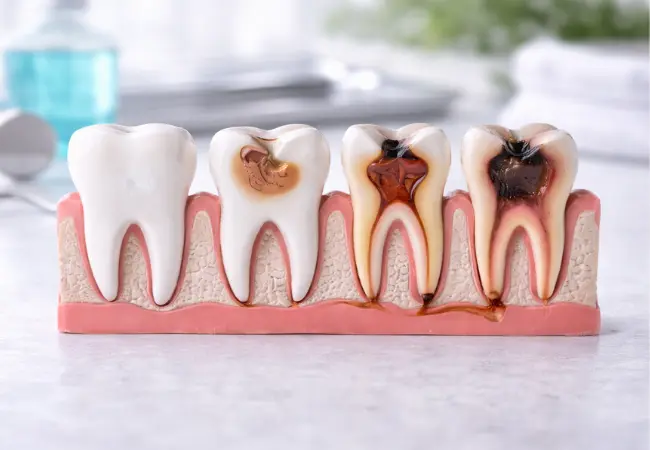
Tooth decay starts when plaque bacteria feed on sugars and starches and produce acids. Those acids pull minerals out of enamel (the outer tooth layer). Over time, decay moves deeper into the tooth if it is not treated. As it reaches deeper layers like dentin and pulp, symptoms usually become more noticeable, and treatment becomes more involved.
The 5 Tooth Decay Stages
Stage 1: Demineralization (the earliest stage)
This is the beginning of tooth decay. The enamel is losing minerals due to repeated acid exposure, but there may not be a true cavity hole yet. You may notice white spots on the tooth, which can be an early sign of mineral loss.
What you might notice
- White chalky spots on a tooth
- No pain yet (very common)
- Maybe mild sensitivity, but often nothing obvious
This is the best stage to catch decay because early enamel weakening can sometimes be slowed or improved with preventive care before it becomes a drilled cavity.
Typical next steps
- Better brushing and flossing
- Fluoride support (to strengthen enamel)
- Professional cleaning and monitoring
- Diet changes if frequent snacking/sugary drinks are a factor
Stage 2: Enamel Decay (the cavity begins)
If demineralization continues, enamel breaks down further, and a small cavity can form. White spots may darken to brown or black areas, and you may start seeing a visible pit or hole.
What you might notice
- Brown, black, or dark spots
- A visible hole or rough area
- Food catching in one spot
- Still may have little to no pain
Even if it does not hurt, enamel decay usually does not “self-heal” once a true cavity hole has formed. This is the point where a small filling is often the easiest fix.
Typical treatment
- Dental filling to stop the cavity from growing
- Exam and X-rays to check if decay spread between teeth
Stage 3: Dentin Decay (decay moves under the enamel)
Dentin is the layer under enamel. It is softer, so decay usually moves faster once it gets here. Dentin also connects more closely to the tooth nerve, which is why symptoms often become more obvious.
What you might notice
- Sensitivity to cold, sweets, or hot drinks
- Pain when chewing
- A deeper-feeling cavity
- More frequent food trapping
This is often when patients finally seek care because symptoms become harder to ignore. The good news is many teeth can still be treated successfully if handled promptly.
Typical treatment
- Filling (if enough tooth structure remains)
- Sometimes a larger restoration if the cavity is extensive
Stage 4: Pulp Damage (the nerve is affected)
The pulp is the inner part of the tooth containing nerves and blood vessels. When decay reaches the pulp, inflammation and pressure can build up inside the tooth, which can lead to significant pain.
What you might notice
- Strong toothache
- Throbbing pain
- Lingering sensitivity (especially hot/cold)
- Pain when biting
- Trouble sleeping due to tooth pain
At this point, the tooth is no longer just a “small cavity” issue. The infection/inflammation risk is much higher, and treatment becomes more urgent.
Typical treatment
- Root canal treatment to remove infected/inflamed pulp and save the tooth
- Often followed by a crown to strengthen the tooth after treatment
Stage 5: Abscess (advanced infection)
An abscess is a serious infection that can form near the root of the tooth if decay is left untreated. This is the most advanced stage of tooth decay and needs urgent dental care.
What you might notice
- Severe, constant pain
- Swelling in the gums, face, or jaw
- Bad taste in the mouth or pus drainage
- Fever (in some cases)
- Pain when chewing or touching the area
This is not a “wait and see” problem. A dental abscess can spread and become more serious if ignored.
Typical treatment
- Urgent exam and X-rays
- Root canal (if the tooth can be saved) or extraction
- Infection management as needed
How to slow or prevent tooth decay from progressing
If you are worried about tooth decay stages, the most important thing is to act before the pain gets severe.
What helps most
- Brush twice daily with fluoride toothpaste
- Floss daily (many cavities start between teeth)
- Limit frequent sugary drinks/snacking
- Get regular checkups and cleanings
- Don’t ignore sensitivity or a new dark spot
How Stadium Dental can help at each stage
If you are in Vancouver and worried about tooth decay, Stadium Dental offers services that match the different stages of decay, including:
- Exams & X-rays to catch early decay and hidden cavities between teeth
- Dental cleanings to remove plaque and tartar buildup
- Dental fillings for enamel and dentin-stage cavities
- Root canal treatment for deeper decay involving the nerve
- Crowns to restore and protect weakened teeth after major decay treatment
Stadium Dental’s service pages list preventive and restorative options, including cleanings, fillings, crowns, exams/X-rays, and root canal treatment.
FAQ: Tooth Decay Stages
What is the first stage of tooth decay?
The first stage is demineralization, where enamel starts losing minerals due to acid from plaque bacteria. It often appears as a white spot and may not cause pain yet.
Can tooth decay be reversed in the early stages?
Early enamel weakening (before a true cavity hole forms) may be improved with fluoride and preventive care. Once a cavity has formed, it usually needs a filling.
How do you know if decay has reached the dentin?
You are more likely to notice sensitivity to hot, cold, or sweets once decay reaches dentin. Symptoms tend to increase as decay moves deeper.
Does tooth decay always hurt?
No. Decay on the enamel surface often does not hurt. Pain becomes more common once it reaches dentin or pulp.
What happens if tooth decay reaches the pulp?
The pulp contains the tooth’s nerve and blood vessels. When decay reaches it, you may get severe pain and may need root canal treatment to save the tooth.
What are the signs of a tooth abscess?
Severe tooth pain, swelling, bad taste, drainage, and sometimes facial swelling can be signs of an abscess. This needs urgent dental care.
Conclusion
Understanding the tooth decay stages helps you catch problems earlier and avoid bigger treatments later. Decay usually starts with silent enamel demineralization, then progresses into enamel cavities, dentin sensitivity, pulp pain, and eventually an abscess if left untreated. The key is not waiting for severe pain. If you notice white spots, dark areas, sensitivity, or food trapping, book an exam while treatment is still simple. At Stadium Dental, you can get the right care at every stage, from preventive cleanings and X-rays to fillings, root canals, and crowns when needed.