
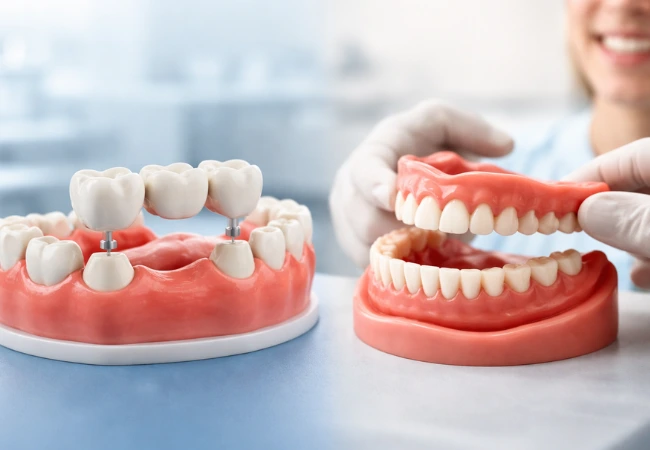
If you are missing teeth, one of the biggest decisions you may face is whether a dental bridge vs. dentures makes more sense for your smile. At first glance, both options do the same job. They replace missing teeth, help restore the look of your smile, and can improve chewing and speech. But they work in very different ways, and the better choice depends on how many teeth you are missing, where the gap is, how healthy your remaining teeth are, and what kind of solution feels realistic for your day-to-day life.
If you choose based only on price or convenience, you can easily pick the wrong option for your situation. The better question is not just “which one replaces teeth?” It is “which one fits your mouth, your habits, and your long-term goals?”
What is a dental bridge?
A dental bridge is used to replace one or more missing teeth by filling the gap in your smile. It is usually held in place by the teeth beside the gap, but in some cases, it can also be supported by implants.
If you have one missing tooth and the teeth around it are strong, a traditional bridge may be a simple and effective solution. It can improve the look of your smile and help you chew more comfortably, all without needing to remove it like a denture.
What are dentures?
Dentures are artificial teeth used to replace several missing teeth or a full arch of missing teeth. They can be full dentures, which replace all teeth in the upper or lower arch, or partial dentures, which replace several missing teeth while some natural teeth remain. Dentures are like removable oral appliances, and there are several types, including full, partial, and implant-supported dentures.
This matters because dentures are usually designed for larger tooth loss situations than bridges. If you are missing all or most of your teeth, dentures are often the more realistic treatment path.
Dental bridge vs. dentures: the core difference
The biggest difference is simple. A bridge is usually fixed and is often used for a smaller gap. Dentures are often removable and are usually used when more teeth are missing. That difference affects almost everything else, including comfort, cleaning, cost, stability, and how natural the replacement may feel in everyday life.
When a dental bridge may be the better option
A bridge may be the better choice if you are missing one tooth or a short span of teeth and still have healthy teeth beside the gap that can support the restoration. A bridge can replace a single missing tooth or a row of missing teeth, typically using crowns on nearby teeth.
A bridge may also be the stronger option if you want something fixed in place rather than removable. Many patients simply prefer not having to take a restoration out at night or remove it for cleaning. That fixed feel can make a bridge seem more like part of your natural smile.
If you care most about replacing a smaller gap with something stable and less bulky than a removable appliance, a bridge often makes more sense than dentures.
When dentures may be the better option
Dentures may be the better choice if you are missing many teeth or all teeth in an arch. Full dentures replace an entire arch, while partial dentures replace several missing teeth. Dentures may also be more practical if a bridge would require too many supporting teeth or if the gap pattern is too large or too scattered for a conventional bridge design to make sense.
This is where people often get lazy with their thinking. They compare dentures and bridges as if they are interchangeable in every case. They are not. A bridge is often a focused solution for a smaller missing area. Dentures are often a broader solution for more extensive tooth loss.
Which one feels more natural?
For many patients, a bridge feels more natural than a removable denture because it stays in place and does not shift in the same way a removable appliance can. Bridges also tend to feel less bulky when replacing a smaller number of teeth because they are not built around a larger removable base. That does not mean dentures always feel awkward. Many patients adapt well to them. But if your question is which option is more likely to feel stable and fixed during everyday chewing and speaking, the bridge usually has the advantage for smaller gaps.
Which one is easier to clean?
This depends on what you are comparing. A removable denture can be taken out for cleaning, which gives you direct access to clean the appliance itself. Denture care still needs regular brushing and cleaning twice a day.
A bridge stays in place, which means you clean around it while it is still in your mouth. That can be convenient because you do not remove it, but it can also require more careful cleaning under the bridge and around the supporting teeth.
So the real answer is not that one is universally easier. Dentures are easier to remove and clean directly. Bridges avoid removal but demand good technique around a fixed restoration.
Which option is better for chewing?
For many people, a bridge provides stronger chewing confidence than a removable denture when replacing a smaller number of teeth. Bridges are fixed in place and can help restore chewing function. Dentures can also restore chewing, but full dentures in particular may feel less stable than a fixed bridge, especially if they are not implant-supported. That is why some patients with dentures eventually ask about implant-supported options.
If your priority is stronger day-to-day chewing for a small missing area, a bridge often has the edge.
Dental bridge vs. dentures cost
This is one of the biggest practical questions.
The exact cost depends on the case, materials, and treatment design, but in many situations, dentures are the more budget-friendly option when replacing many teeth, while a bridge may be reasonable for a smaller gap. Dentures are commonly used for broader tooth loss, and bridges are usually more targeted solutions.
The smarter way to think about cost is not just “what is cheapest today?” It is “what is the right level of treatment for the amount of tooth loss I actually have?” A bridge may be more sensible for one missing tooth. Dentures may be more sensible if you are replacing an entire arch.
How long do they last?
Dentures and bridges both need maintenance, and neither should be treated as something you can ignore after placement. Usually, the average lifespan of a denture is around seven to 10 years. On the other hand, bridges often last about five to 15 years.
That range tells you something important. Longevity depends heavily on care, fit, bite forces, and the condition of the teeth or tissues supporting the restoration. The treatment only works well long-term if you maintain it well.
What we discuss with patients at Stadium Dental
At Stadium Dental, we help patients compare bridges and dentures based on what actually fits their mouth and long-term goals. We offer crowns, bridges, dentures, implants, and other restorative options, so when you come to us with missing teeth, we can look at more than one path forward.
When we talk through a bridge vs. denture decision, we do not just look at the gap. We look at how many teeth are missing, the health of the teeth that remain, your bite, your comfort, and how you want the restoration to function in daily life. In some cases, a bridge is the simpler and more natural-feeling option. In other cases, dentures are the more practical and appropriate solution.
Our goal is not to force one treatment because it sounds better on paper. Our goal is to help you choose the option that makes the most sense for your smile, your routine, and your long-term oral health.
FAQ: Dental bridge vs. dentures
Is a dental bridge better than dentures?
It can be, but usually only for smaller gaps. A bridge is often better when you are missing one tooth or a short row of teeth, while dentures are usually better when many teeth are missing.
Do dental bridges feel more natural than dentures?
Often, yes. Because a bridge is fixed in place, it often feels more stable and less bulky than a removable denture when replacing a smaller number of teeth.
Are dentures cheaper than bridges?
They often are when you are replacing many teeth, but the right comparison depends on how much tooth loss you actually have. Dentures are generally the broader solution for larger-scale replacement.
Can a bridge replace all your teeth?
No. Bridges are generally used for one tooth or a row of missing teeth, not an entire arch. Full dentures are used when all teeth in an arch are missing.
Are dentures removable?
Yes. Dentures are a removable oral object.
How long do bridges and dentures last?
Dentures often last around seven to 10 years, while bridges often last about five to 15 years, depending on care and clinical factors.
Conclusion
If you are comparing dental bridge vs. dentures, the right answer depends less on which one sounds better and more on what problem you are actually trying to solve.
A bridge is often the stronger option for a smaller missing area when you want something fixed in place. Dentures are often the stronger option when you need to replace many teeth or a full arch. Both can work well, but they are not designed for the same situations.