
If you are considering a bridge to replace a missing tooth, you are probably asking a practical question: What are the disadvantages of having dental bridge treatment?
A dental bridge can be an effective way to replace one or more missing teeth, restore chewing, and improve the look of your smile. It is a fixed replacement, which means it stays in place and does not come out like a removable denture. But that does not mean it is the best choice for every situation. Bridges come with real tradeoffs, and if you skip those tradeoffs, you can make the wrong decision for your mouth. The goal of this article is not to talk you out of a dental bridge. It is to help you understand where bridges can fall short, so you can make a better decision.
What is a dental bridge?
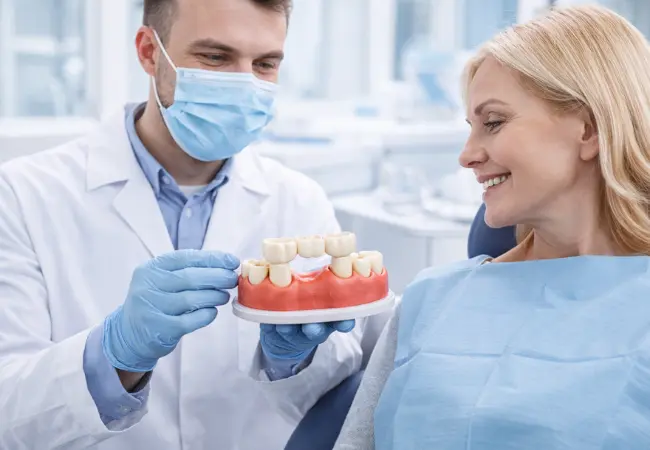
A dental bridge is a fixed restoration that fills the space left by one or more missing teeth. In many cases, it uses the teeth next to the gap for support. Those supporting teeth are usually prepared for crowns, and the false tooth in the middle bridges the space. NHS guidance describes a bridge as a fixed replacement for a missing tooth or teeth that are supported by the surrounding teeth.
That design works well in the right case. But it also explains why bridges have limitations.
10 Disadvantages of having a Dental Bridge
1. A dental bridge usually depends on other teeth
One of the biggest disadvantages of having dental bridge is that it often relies on the teeth beside the gap.
That matters because the bridge does not stand on its own. The neighboring teeth become the support system. If those teeth are not strong enough, healthy enough, or positioned well enough, the bridge may not be the ideal treatment. This is one of the biggest strategic differences between a bridge and an implant. A bridge usually depends on nearby teeth. An implant usually does not.
2. Healthy teeth may need to be reshaped
This is the part many patients do not realize at first. If you get a traditional bridge, the teeth beside the gap usually need to be reshaped to hold crowns. That means some natural tooth structure is removed, even if those teeth were otherwise healthy.
That does not automatically make bridges bad. But it does mean the treatment involves compromise. If the supporting teeth are already heavily filled, broken down, or crowned, that compromise may make sense. If they are healthy and untouched, you should think harder before choosing a bridge over alternatives.
3. Supporting teeth can develop problems later
Once a bridge depends on nearby teeth, the long-term health of those teeth matters a lot. If one supporting tooth develops decay, infection, or gum disease, the whole bridge can be affected. Conventional bridges can affect the nerve of the supporting tooth, and in a small percentage of cases, the nerve may be irreversibly damaged and require root canal treatment.
This is not a reason to panic. It is a reason to think clearly. A bridge can work well, but it also creates a shared fate between the replacement tooth and the teeth holding it up.
4. Bridges do not preserve bone like implants do
A bridge replaces the visible tooth. It does not replace the root. That matters because when a tooth root is missing, the bone in that area can gradually shrink over time. Implants preserve existing bone and reduce the risk of future bone loss, while bridges do not offer that same benefit.
So if your priority is long-term bone support in the area of the missing tooth, this is a real disadvantage of having dental bridge instead of an implant.
5. Bridges can be harder to clean than people expect
A bridge is fixed, which many people like. But fixed does not mean maintenance-free. Cleaning around and under a bridge can be more difficult than cleaning a single natural tooth or a single implant crown. Bridges are harder to clean than implants, and a single implant is typically easier to keep clean than a bridge.
This matters more than patients think. If your cleaning habits are inconsistent, plaque can build up around the supporting teeth and gums. The bridge may look fine from the outside, while the teeth holding it up slowly become the weak point.
6. Bridges usually do not last as long as implants
Another disadvantage of having dental bridge is durability. Bridges can last for years, but in general they do not last as long as implants. Dental crowns, which are part of many bridges, are also commonly cited as lasting in that same general range with proper care.
That does not mean a bridge will fail early. It means you should not think of it as a lifetime solution by default.
7. Bridges may be less ideal for larger gaps
A bridge can replace a tooth or a short row of teeth, but that does not mean it is the best fit for every missing-tooth pattern. If the gap is too large, if the supporting teeth are weak, or if many teeth are missing across an arch, another approach may be more appropriate. Bridges are common for missing teeth, but also dentures for most or all missing teeth, while implant-supported options are relevant in broader restorative cases.
So if you are trying to stretch a bridge into a situation it was not really built for, that is a planning problem, not just a product problem.
8. A bridge may not be the most conservative long-term choice
A lot of people assume a bridge is the simpler option, and in some ways it is. It usually avoids surgery and can often be completed faster than an implant. But simpler today does not always mean more conservative long-term. Because a bridge uses neighboring teeth for support, you are involving more than the missing tooth site in the treatment plan.
This is exactly why you should stop thinking only in terms of speed or upfront convenience.
9. If the bridge fails, replacement can become more complicated
When a bridge reaches the end of its life, or one supporting tooth fails, replacing it may not be as simple as repeating the same treatment.
The condition of the support teeth may have changed. The gums may have changed. The bite may have changed. If one support tooth is lost, the original bridge design may no longer be possible. This is an inference based on the fact that bridges depend on supporting teeth, and those teeth can develop nerve damage, infection, or restorative failure over time. That means the exit path from a bridge can be more complicated than patients expect.
10. A bridge is not always the best value, even if it costs less upfront
This is the part people often get wrong. A bridge usually costs less up front than an implant. Cleveland Clinic says this directly. But it also says bridges are less durable and harder to clean, while implants last longer.
So the smarter question is not “which is cheaper today?” It is “which creates the best value over the life of the treatment?” If a bridge needs replacement earlier, affects support teeth, or creates cleaning challenges, the lower upfront cost may not tell the whole story.
What we tell patients at Stadium Dental
At Stadium Dental, we do not treat a bridge as an automatic answer just because a tooth is missing. We offer crowns and bridges, implants, dentures, and other restorative options, so when you come to us, we can look at more than one way to restore your smile.
When we evaluate whether a bridge makes sense, we look at the gap, the health of the teeth next to it, your bite, your long-term goals, and whether an implant-supported option may be a stronger fit. In some situations, a bridge is practical and effective. In others, it creates compromises that are not worth it. Our job is to help you understand those tradeoffs clearly so you can choose the option that fits your mouth, not just the option that sounds easiest today.
FAQ: Disadvantages of Having a Dental Bridge
What is the main disadvantage of having a dental bridge?
One of the main disadvantages is that a traditional bridge usually depends on neighboring teeth for support, which often means reshaping those teeth for crowns.
Can a dental bridge damage other teeth?
It can affect the supporting teeth because those teeth carry the bridge. Conventional bridges can be destructive to supporting teeth and may affect the nerve in some cases.
Are dental bridges hard to clean?
They can be. Bridges are harder to clean than implants, and a single implant is usually easier to keep clean than a bridge.
Do bridges last as long as implants?
No, not usually. Implants generally last much longer than bridges.
Can a bridge cause bone loss?
A bridge does not replace the tooth root, so it does not preserve bone in the way an implant can. Implants help preserve bone and reduce future bone loss.
Is a bridge still a good option for missing teeth?
Yes, in the right case. A bridge can still be an effective fixed solution, especially when support teeth already need crowns or when implant treatment is not the right fit.
Conclusion
If you are researching the disadvantages of having a dental bridge treatment, the honest answer is that the biggest drawbacks usually come down to dependence on nearby teeth, extra cleaning demands, shorter average lifespan compared with implants, and the fact that bridges do not preserve bone at the missing tooth site.
That does not mean a bridge is the wrong choice. It means you should choose one with your eyes open.