
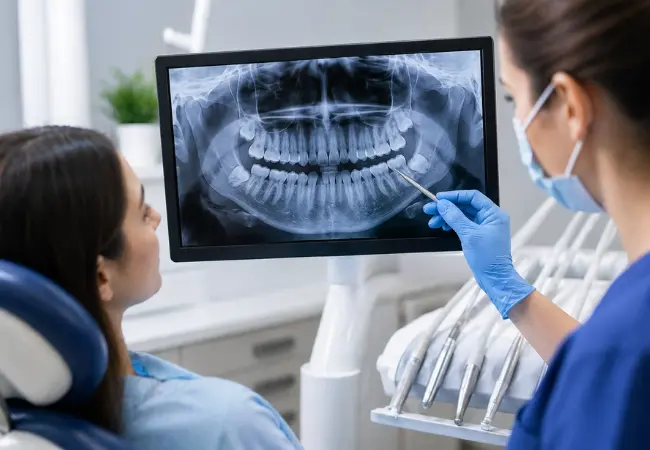
If your dentist recommends dental X-rays, you may wonder if they are really necessary. After all, if your teeth look fine and nothing hurts, why would you need images taken? Dental X-rays help your dentist see what is happening under the surface. They can show cavities between teeth, infections near the roots, bone loss, impacted teeth, wisdom teeth problems, tooth development in children, and issues under old fillings or crowns. Without X-rays, some problems can stay hidden until they become painful, expensive, or harder to treat.
At Stadium Dental in Downtown Vancouver, we use dental exams and X-rays to diagnose problems accurately and create clear treatment plans. Our goal is not to take unnecessary images. Our goal is to understand your oral health properly so you can get the right care at the right time.
What Are Dental X-Rays?
Dental X-rays, also called dental radiographs, are images that help your dentist see parts of your teeth, roots, jawbone, and surrounding structures that are not visible during a regular exam.
During a visual exam, your dentist can see the surfaces of your teeth, gums, tongue, and mouth. But your dentist cannot always see between tight teeth, under existing dental work, below the gumline, or inside the bone.
That is where dental X-rays help.
The American Dental Association explains that dental radiographs help dentists diagnose damage and disease that cannot be seen during a regular dental exam. How often they are needed depends on your oral health, age, disease risk, and symptoms.
Why Dental X-Rays Matter
Here is the blunt truth: waiting for pain is a bad dental strategy.
Many dental problems start quietly. A small cavity between two teeth may not hurt. Gum disease can cause bone loss before you notice loose teeth. An infection can develop near a tooth root before the pain becomes intense. A child’s adult tooth may be blocked or coming in at the wrong angle before it becomes obvious.
Dental X-rays allow your dentist to catch issues earlier. They can help show:
- Cavities between teeth.
- Decay under old fillings or crowns.
- Bone loss from gum disease.
- Tooth infections or abscesses.
- Impacted wisdom teeth.
- Jawbone changes.
- Tooth root problems.
- Cysts or unusual growths.
- Children’s tooth development.
- Teeth that have not erupted yet.
- Cracks or damage that may not be visible during a basic exam.
What Can Dental X-Rays Show That a Regular Exam Cannot?
A regular dental exam is important, but it has limits. Your dentist can check your teeth, gums, bite, and visible dental work. But some areas are hidden. For example, cavities often form between teeth where toothbrush bristles cannot reach well. These cavities may not be visible until they become larger.
Dental X-rays can also show what is happening below the gumline. This matters for gum disease, bone support, tooth roots, dental implants, and infections. If you have tooth pain, X-rays may help identify whether the problem is decay, infection, trauma, a root issue, or another concern. If you are planning treatment such as a crown, bridge, dental implant, Invisalign, extraction, or root canal, X-rays may help your dentist plan more accurately.
Are Dental X-Rays Safe?
Dental X-rays use radiation, so it is reasonable to ask about safety. You should never feel embarrassed for asking. Modern dental X-rays use low levels of radiation. Health Canada states that medical and dental X-rays can provide valuable information about a patient’s condition and are regulated under Canadian radiation and medical device requirements.
The Canadian Dental Association also emphasizes radiation control in dentistry, including appropriate shielding and limiting the X-ray beam to the minimum area needed for the exam. This is the standard your dentist should follow: take X-rays only when they are clinically useful, use the proper technique, and avoid unnecessary exposure.
How Often Do You Need Dental X-Rays?
There is no single schedule that fits everyone. Some people need X-rays more often because they have a higher risk of cavities, gum disease, infections, or dental complications. Others may need them less often if they have stable oral health and a low risk. You may need dental X-rays more often if you:
- Have a history of frequent cavities.
- Have gum disease or bone loss.
- Have tooth pain or swelling.
- Have deep fillings, crowns, bridges, or implants.
- Are planning orthodontic treatment.
- Are planning dental implant treatment.
- Have wisdom teeth concerns.
- Have had dental trauma.
- Have dry mouth.
- Have a high-sugar diet or frequent snacking habits.
- Are you a child or teen with developing teeth?
- Are a new patient, and your dentist needs a baseline view.
You may need them less often if your teeth and gums are healthy, you have no symptoms, and your risk for disease is low.
Do Children Need Dental X-Rays?
Children may need dental X-rays because their teeth and jaws are still developing. X-rays can help check whether adult teeth are forming properly, whether teeth are coming in at the right angle, whether there are cavities between baby teeth, and whether orthodontic concerns are developing.
This matters because children may not always complain about dental problems. A cavity between baby teeth can grow quietly. Adult teeth can be blocked or crowded before they are visible.
That does not mean children should get X-rays at every visit. Just like adults, children should only have X-rays when they are needed based on risk, symptoms, development, and clinical findings.
Are Dental X-Rays Safe During Pregnancy?
If you are pregnant or may be pregnant, tell your dentist before X-rays are taken. Dental care is still important during pregnancy, and urgent dental problems should not be ignored. Your dentist will weigh the need for X-rays based on your symptoms and treatment needs. If imaging is necessary, safety protocols can be used. Do not skip dental care automatically because you are pregnant. A dental infection or untreated pain can become a bigger health issue. The responsible move is to tell your dentist and discuss what is necessary.
What Happens During Dental X-Rays?
Dental X-rays are usually quick. You may be asked to bite gently on a small sensor or holder while the image is taken. For a panoramic X-ray, you may stand or sit while a machine moves around your head. The process is usually painless, although some people find the bitewing sensor uncomfortable for a few seconds. If you have a strong gag reflex, small mouth, jaw pain, or dental anxiety, tell the dental team. They can help make the process easier.
At Stadium Dental, we want patients to understand what is happening before we do anything. If you are nervous, we can explain each step and give you time to ask questions.
Why Your Dentist May Recommend X-Rays Even If Nothing Hurts
This is where many patients make costly mistakes. No pain does not always mean no problem. Cavities, gum disease, infections, and bone changes can begin before you feel symptoms. By the time pain appears, the issue may be more advanced.
Dental X-rays are often preventive. They help your dentist find problems earlier, when treatment may be simpler. For example, a small cavity may need a tooth filling. A deeper cavity may need a crown or root canal. A severely damaged tooth may need extraction. Earlier information gives you better options.
How Stadium Dental Helps With Exams and Dental X-Rays in Vancouver
If you need dental X-rays in Vancouver, Stadium Dental can help you understand what is happening with your teeth, gums, roots, and jaw before problems become more serious. We do not use X-rays to scare you into treatment. We use them to give you clearer answers. Dental X-rays can help us identify issues that may not be visible during a regular exam, including cavities between teeth, infection, bone loss, wisdom teeth concerns, and treatment planning needs.
At Stadium Dental in Downtown Vancouver, we provide exams and X-rays, cleanings, white fillings, crowns and bridges, dental implants, extractions, Invisalign, children and adult dentistry, cosmetic dentistry, Botox for TMJ, and other dental services. Stadium Dental’s website notes that the clinic performs general dentistry services such as cleanings, white fillings, crowns and bridges, dental implants, and extractions for all ages.
If you are due for a dental exam, have tooth pain, need a second opinion, or want to check your oral health before starting treatment, we can help you take the next step.
FAQs About Dental X-Rays
What are dental X-rays used for?
Dental X-rays are used to help detect problems that may not be visible during a regular exam, including cavities between teeth, infections, bone loss, impacted teeth, wisdom teeth issues, root problems, and tooth development concerns.
Are dental X-rays safe?
Modern dental X-rays use low levels of radiation and are regulated for safety. Dentists should only recommend X-rays when the images are clinically useful and should use proper radiation control practices.
How often should you get dental X-rays?
There is no one-size-fits-all schedule. Your need for dental X-rays depends on your age, oral health, risk for cavities or gum disease, symptoms, and treatment needs.
Do dental X-rays hurt?
No. Dental X-rays do not hurt. You may feel brief discomfort from biting on a sensor or holder, especially if you have a small mouth, sensitive gums, or a strong gag reflex.
Can dental X-rays show cavities?
Yes. Dental X-rays can show cavities, especially between teeth or under existing dental work, where decay may not be visible during a regular visual exam.
Can I get dental X-rays while pregnant?
Tell your dentist if you are pregnant or may be pregnant. Your dentist will recommend X-rays only when necessary and will follow appropriate safety precautions.
Why does my dentist need X-rays if my teeth do not hurt?
Many dental problems do not cause pain at first. X-rays can help find cavities, infection, bone loss, and other hidden issues earlier, when treatment may be simpler.
Does Stadium Dental offer dental X-rays in Vancouver?
Yes. Stadium Dental offers exams and X-rays in Downtown Vancouver, along with cleanings, white fillings, crowns and bridges, dental implants, extractions, Invisalign, children and adult dentistry, cosmetic dentistry, and Botox for TMJ.
Conclusion
Dental X-rays are an important part of modern dental care because they help your dentist see what is hidden below the surface. They can reveal cavities, infections, bone loss, impacted teeth, wisdom teeth problems, and other concerns before they become more serious. You do not need X-rays at every visit just because. You need them when they can help your dentist make a better diagnosis or treatment plan. If it has been a while since your last dental exam or you are worried about a tooth, book a visit with Stadium Dental and find out what is really going on before the problem gets worse.