
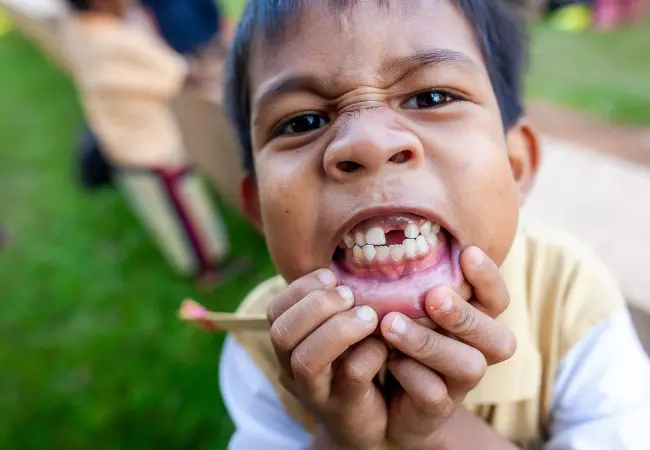
If you’re reading this because it just happened, skip ahead to the steps below, they matter more than anything else on this page right now. A knocked-out tooth is a genuine dental emergency, but here’s the encouraging part: acting quickly in the next 30 to 60 minutes gives you a real chance of saving it.
What to Do If a Tooth Is Knocked Out (Do This First)
- Stay calm and find the tooth. Pick it up by the crown (the white, chewing part), never by the root. Touching the root can damage the tiny fibers needed for successful reattachment.
- Rinse it gently, if needed. If it’s dirty, rinse briefly with plain water or milk. Don’t scrub it, don’t use soap, and don’t dry it off with a towel.
- Try to put it back in the socket. If you can, gently reinsert the tooth into its socket, facing the right way, and hold it in place by biting down softly on a clean cloth or gauze. This is genuinely the best thing you can do, since a tooth reinserted quickly has a much higher chance of survival.
- If you can’t put it back in, keep it moist. Place the tooth in a container of milk, this is the best option, since milk helps preserve the tooth’s root surface. If milk isn’t available, tuck the tooth inside your cheek (being careful not to swallow it) or use your own saliva. Never store it in plain tap water, since it can actually damage the root cells.
- Get to a dentist immediately. Time matters enormously here. Teeth reinserted within 30 minutes have the best chance of long-term success, and the odds drop significantly the longer you wait. Call ahead so the clinic knows you’re coming and can prepare for an emergency visit.
If it’s after hours, go to an emergency room or urgent care dental clinic rather than waiting until morning. This genuinely isn’t something that can wait.
Why Does the Tooth Need to Stay Moist?
The root surface of your tooth is covered in delicate periodontal ligament fibers, the same fibers that normally anchor your tooth to your jawbone. These fibers can survive outside your mouth for a while, but only if they stay moist. Letting the tooth dry out, even for a few minutes, damages these fibers and significantly lowers the chance your dentist can successfully save the tooth.
This is exactly why milk works so well as a storage option, it’s gentle on those delicate cells in a way that plain water isn’t.
What Happens at the Dentist
Once you get to a dentist or emergency room, here’s generally what to expect:
- Assessment. Your dentist will check the tooth and socket, and may take an X-ray to rule out other damage, especially if the injury involved a hard fall or impact.
- Reinsertion (if not already done). If you weren’t able to put the tooth back in yourself, your dentist will do this, following the same careful process.
- Splinting. A small splint is typically used to hold the tooth in place against neighboring teeth while it heals, usually for a couple of weeks.
- Follow-up care. You’ll likely need a soft food diet, gentle brushing, and an antibacterial rinse for a couple of weeks, along with follow-up visits to monitor healing.
- Root canal, if needed. In many cases, a root canal is eventually needed on a reinserted tooth, since the nerve and blood supply are often affected by the injury, even when the tooth itself is successfully saved.
How to Save a Knocked Out Tooth: Does It Actually Work?
Yes, and more often than people expect, especially when the steps above are followed quickly. A successfully reinserted tooth can often function normally for many years, sometimes a decade or more, though it’s worth knowing it may eventually need to be addressed again down the line, since reinserted teeth don’t always last a lifetime the way an undisturbed natural tooth would.
That said, success isn’t guaranteed, and it depends heavily on how quickly you acted, how the tooth was handled, and the nature of the injury itself. Even if reinsertion doesn’t ultimately succeed long term, acting fast is still worthwhile, since it gives you and your dentist the best possible chance.
Important: What NOT to Do
A few common instincts can actually hurt your chances, so it’s worth knowing what to avoid:
- Don’t touch the root of the tooth; only handle it by the crown
- Don’t scrub or clean it aggressively; a gentle rinse is enough
- Don’t let it dry out, even for a few minutes
- Don’t store it in plain water
- Don’t try to reinsert a baby tooth. If it’s a child’s baby tooth that’s been knocked out, don’t attempt to put it back in, this can actually damage the developing permanent tooth underneath. Still see a dentist promptly to check for any other injury.
- Don’t wait to “see how it feels.” This is a genuine emergency, and delay is the single biggest factor working against you.
What If the Tooth Can’t Be Saved?
Sometimes, despite doing everything right, a tooth can’t be successfully reinserted, whether due to how much time has passed, the extent of the damage, or other factors your dentist will assess. If that happens, you still have solid options for replacing it, including:
- A dental bridge, which fills the gap using your neighboring teeth for support
- A partial denture, a removable option that fills the gap
- A dental implant, a long-term, permanent replacement that functions and looks like a natural tooth
If it comes to this, our guide on dental implants walks through how the process works and what makes them such a strong long-term option for replacing a tooth that couldn’t be saved.
Preventing a Knocked Out Tooth: Sports Mouthguards
A large share of knocked-out teeth happen during sports, falls, and bike accidents, and while you can’t prevent every accident, a properly fitted sports mouthguard dramatically reduces your risk if you or your kids play contact sports like hockey, football, basketball, or martial arts.
Custom-fitted mouthguards, made specifically for your teeth by a dentist, offer significantly better protection and comfort than generic “boil and bite” versions from a sporting goods store, since a proper fit stays securely in place during actual impact, exactly when you need it most.
Emergency Care for a Knocked Out Tooth at Stadium Dental in Vancouver
If you or your child has a knocked-out tooth, Stadium Dental offers emergency and walk-in appointments to give you the best possible chance of saving it.
Here’s what makes emergency care easier at Stadium Dental:
- Emergency and walk-in appointments, so you’re not stuck waiting when every minute genuinely counts
- Fast, careful reinsertion and splinting, along with X-rays to check for other injury
- Root canal treatment available in-house, in case it’s needed as part of follow-up care
- Replacement options, including dental implants and bridges, if the tooth ultimately can’t be saved
- Custom sports mouthguards, to help protect your teeth (or your child’s) going forward
- A multilingual team, including Mandarin, Cantonese, Punjabi, Russian, and Ukrainian, so you can communicate clearly even in a stressful moment
- A convenient downtown location at 178 Keefer Place, right next to the Stadium-Chinatown SkyTrain station, with free parking available
If a tooth has just been knocked out, don’t wait; call us right away so we can guide you through the next steps and get you in as quickly as possible.
Dealing with a dental emergency right now? Call us immediately at 604-559-0299, or book online for non-urgent follow-up care.
Frequently Asked Questions About Knocked-Out Teeth
What should I do immediately if a tooth is knocked out?
Pick it up by the crown, rinse it gently if dirty, try to reinsert it into the socket if possible, and get to a dentist within 30 to 60 minutes. If you can’t reinsert it, store it in milk to keep it moist.
How can I save a knocked-out tooth?
Acting quickly is the most important factor. Handle the tooth carefully by the crown, keep it moist at all times, and see a dentist as soon as possible, ideally within 30 minutes to an hour of the injury.
Why should a knocked-out tooth be stored in milk?
Milk helps preserve the delicate root surface cells better than water, which can actually damage them. If milk isn’t available, storing the tooth in your cheek using your own saliva is also effective.
Should I try to reinsert a knocked-out baby tooth?
No, baby teeth should not be reinserted, as it can harm the developing permanent tooth underneath. Still, see a dentist promptly to check for other injuries.
What if my knocked-out tooth can’t be saved?
Options like dental bridges, partial dentures, and dental implants can effectively replace a tooth that can’t be reinserted, restoring both function and appearance.
Can a sports mouthguard actually prevent a knocked-out tooth?
Yes, a properly fitted, custom mouthguard significantly reduces the risk of a knocked-out tooth during contact sports, offering better protection and fit than generic store-bought versions.
Conclusion
A knocked-out tooth is one of the few dental situations where minutes genuinely matter. Handling the tooth by the crown, keeping it moist in milk or your cheek, and getting to a dentist within 30 to 60 minutes gives you the best real chance of saving it. Even if reinsertion isn’t possible, effective replacement options are available, so while this moment is stressful, it isn’t the end of your smile. If it’s happened to you or your child, don’t wait; call a dentist immediately.