
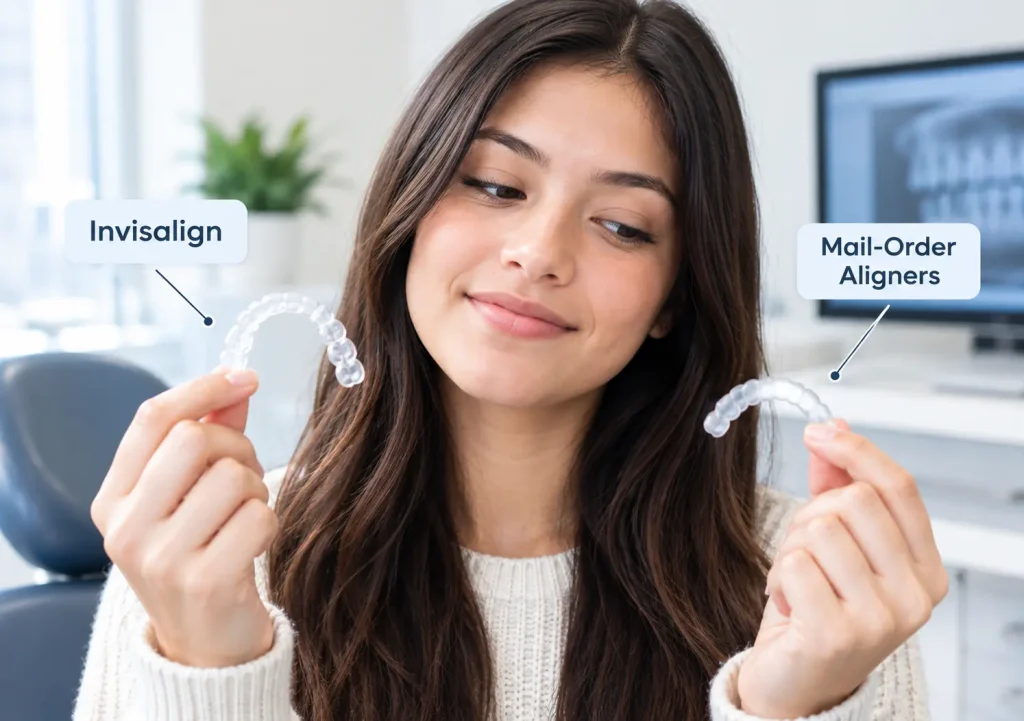
If you want straighter teeth without traditional braces, you’ve probably come across several clear aligner options. Some treatments, such as Invisalign, are provided through a dentist or orthodontist. Others are marketed as mail-order aligners, allowing you to start treatment from home with little or no routine in-person care. At first glance, the two options may seem similar. Both use clear plastic trays designed to move your teeth gradually, and both may advertise a more discreet alternative to metal braces. However, the process behind your treatment can be very different. When comparing Invisalign vs. mail-order aligners, you need to look beyond the price and appearance of the trays. Your dental health, treatment complexity, diagnostic records, professional supervision, and access to adjustments all matter.
Mail-order aligners may appear convenient and less expensive upfront, but limited clinical assessment can leave important dental problems undetected. Professionally supervised Invisalign treatment begins with an evaluation and allows your dentist to monitor your progress and make changes when necessary. In this guide, you’ll learn how the two options compare, which at-home aligner risks you should understand, and what to consider before choosing a treatment for your smile.
What Is the Difference Between Invisalign and Mail-Order Aligners?
The main difference between Invisalign and mail-order aligners is how your treatment is planned and supervised.
Invisalign is a branded clear aligner system provided through participating dental professionals. Your treatment begins with a clinical assessment, followed by a customized plan designed around your teeth and bite. Your dentist or orthodontist monitors your progress and determines whether adjustments are needed. Mail-order aligners, also called direct-to-consumer aligners, are typically ordered online. Depending on the provider, you may take impressions at home or visit a scanning location before receiving your aligners by mail. Treatment monitoring may take place remotely, and the amount of in-person clinical care varies between providers.
Here’s how the two approaches generally compare:
- Initial assessment: Invisalign treatment includes an examination by a dental professional. Mail-order providers may rely primarily on submitted impressions, scans, questionnaires, or remote assessments.
- Diagnostic testing: Your Invisalign provider may recommend X-rays and other records to assess your dental health and treatment needs. Mail-order programs may not include the same comprehensive in-person evaluation.
- Treatment monitoring: With Invisalign, your provider can examine your teeth and bite during follow-up visits. Mail-order programs often rely more heavily on remote monitoring.
- Treatment adjustments: A dentist can reassess your teeth, modify the treatment plan, and arrange additional aligners when necessary. The options available through mail-order services depend on the provider.
- Case suitability: Professionally supervised treatment can be planned around a wider range of dental needs, although Invisalign is not appropriate for every case. Many mail-order programs focus on relatively minor alignment concerns.
These differences are important because clear aligners are orthodontic devices, not simply cosmetic accessories. Moving teeth changes their position within the supporting bone and can affect how your upper and lower teeth meet. If you’re learning about Invisalign treatment at Stadium Dental in Downtown Vancouver, you can explore how a dentist-led treatment plan is developed around your individual dental needs.
Invisalign vs. Mail-Order Aligners: 6 Important Differences
When deciding between the two approaches, consider how each one addresses your dental health, treatment goals, and need for professional care.
1. Professional Supervision and Dental Examinations
One of the most important differences in the Invisalign vs. mail-order aligners comparison is the level of professional involvement. Before starting Invisalign, your dentist evaluates your teeth, gums, bite, and overall oral health. X-rays or other diagnostic records may be necessary to assess the roots of your teeth, supporting bone, and underlying dental conditions. This assessment helps determine whether clear aligners are suitable for you and whether any problems need attention before treatment begins.
Mail-order providers may use photographs, digital scans, or impressions to assess your alignment remotely. Some arrange consultations with licensed dental professionals, but the process and extent of in-person examinations vary. The limitation is not simply that you receive aligners in the mail. It’s whether a qualified professional has enough diagnostic information to determine that treatment is appropriate and monitor how your teeth respond. A set of impressions can show the shape of your teeth, but it cannot independently establish the health of your roots, gums, supporting bone, or bite.
2. Treatment Planning and Customization
Your teeth don’t all move in the same way. Some require simple tipping movements, while others may need more complex adjustments involving rotation, vertical positioning, or bite correction.
With Invisalign, your dentist or orthodontist develops a treatment plan based on your examination and diagnostic records. Depending on your needs, the plan may incorporate attachments, elastics, interproximal reduction, or other techniques to help achieve specific tooth movements. Mail-order systems generally use a treatment plan based on the records submitted to the provider. The amount of customization and the types of tooth movements available depend on the company’s process and clinical protocols.
This matters because a digitally generated preview of straighter teeth does not guarantee that every planned movement will occur exactly as predicted. Your dentist needs to evaluate how your teeth respond throughout treatment and determine whether the original plan remains appropriate.
3. Which Dental Problems Can Be Treated?
Both Invisalign and mail-order aligners can be designed to address certain spacing and crowding concerns. However, the complexity of your case determines which approach is appropriate. Professionally supervised Invisalign treatment can address many alignment problems, including some bite irregularities and more involved tooth movements. More complex cases may require additional techniques or a different orthodontic treatment altogether. Mail-order aligners are generally marketed toward people with relatively minor cosmetic alignment concerns. They may not be suitable for significant crowding, complex bite problems, substantial rotations, or cases requiring more extensive tooth movement.
Even a small gap between your front teeth can have an underlying cause that isn’t obvious from photographs alone. If your goal is to improve your smile, don’t assume that your teeth are suitable for remote treatment simply because the visible alignment problem looks minor. An examination can help identify whether clear aligners are appropriate and which treatment approach is likely to meet your needs.
4. Monitoring Progress and Making Adjustments
Your teeth may not move exactly as predicted in your initial treatment plan. An aligner might stop fitting properly, a tooth may not track as expected, or your bite may change during treatment. With professionally supervised Invisalign, your dentist can examine these changes and determine what to do next. Depending on the situation, you may need additional aligners, a revised treatment plan, or another approach to complete treatment safely. Mail-order providers may offer progress photographs, virtual check-ins, or remote consultations. These services can help identify some problems, but they may not replace an in-person examination when a clinical issue requires closer assessment. Before choosing any aligner provider, find out how problems are handled. Ask who reviews your progress, how quickly you can speak with a clinician, and whether you can receive an in-person examination if your teeth or gums develop a problem.
5. Treatment Duration and Final Results
Neither Invisalign nor mail-order aligners can guarantee a particular treatment duration or final result. Your timeline depends on the movements required, the complexity of your case, your biological response, and how consistently you follow the prescribed wear schedule. Some minor alignment concerns may be addressed within several months, while more involved Invisalign cases may take a year or longer. Mail-order treatment duration also varies according to the provider’s plan and the movements being attempted. A shorter advertised timeline doesn’t necessarily mean a better treatment. Your teeth need to reach appropriate positions, and your bite should be assessed rather than judged only by how straight your front teeth appear.
When comparing clear aligners vs. Invisalign, ask what happens if your teeth don’t move as expected. Find out whether refinements are included, whether further clinical assessment is available, and what additional costs might apply if your original plan needs to change.
6. Cost and Overall Value
Mail-order aligners often appeal to people looking for a lower upfront price. However, the initial price doesn’t always reflect the full cost of treatment. When comparing options, consider whether the quoted amount includes diagnostic examinations, follow-up care, additional aligners, refinements, and retainers. You should also understand the provider’s policy if your treatment needs to be paused or changed. Professionally supervised Invisalign treatment includes clinical care alongside the aligners. The cost can reflect treatment planning, appointments, monitoring, and adjustments throughout the process.
If a remote treatment produces an unsatisfactory result or causes a problem that requires corrective care, you may face additional expenses. This is not inevitable with every mail-order program, but it’s a possibility worth considering. You can review Stadium Dental’s Invisalign pricing and payment options to understand what its stated treatment fees include. Compare the full treatment arrangements rather than choosing solely by the lowest advertised price.
What Are the Risks of At-Home Aligners?
Understanding at-home aligner risks is essential before you begin any treatment that moves your teeth without routine in-person supervision.
The level of risk depends on your dental health, the complexity of your case, the provider’s screening process, and the availability of appropriate clinical monitoring. The following concerns are particularly important when a treatment proceeds without a comprehensive examination or adequate follow-up.
1. Undetected Tooth Decay or Gum Disease
If you have untreated cavities, gum inflammation, or periodontal disease, orthodontic treatment may need to be delayed until those problems are addressed. An initial impression or photograph may not reveal all underlying dental conditions. Without appropriate screening, a problem could remain undetected while your teeth are being moved. A dental examination helps identify conditions that could affect your treatment and allows your provider to recommend care before proceeding.
2. Unwanted Tooth Movement or Bite Changes
Straightening your visible front teeth doesn’t automatically produce a healthy bite. Your upper and lower teeth need to meet in a functional way. If your treatment changes their relationship without appropriate planning and monitoring, you may develop new bite problems or find that your teeth no longer fit together comfortably. Potential warning signs include difficulty biting, new uneven contact between teeth, or a noticeable change in how your teeth meet. If this happens during aligner treatment, stop progressing through the trays until you’ve received instructions from a qualified dental professional.
3. Gum Recession and Supporting Bone Problems
Your teeth are supported by gums and bone. Orthodontic movement needs to be planned with those supporting structures in mind. Moving teeth outside the limits of their supporting bone or proceeding when periodontal health is compromised can contribute to gum recession or other complications. These problems may not be visible in a set of photographs. A clinical examination, and sometimes additional diagnostic records, helps your dentist assess the relevant risks.
4. Root Damage and Other Complications
Orthodontic tooth movement can sometimes contribute to root resorption, a process in which part of a tooth’s root becomes shorter. The risk varies according to individual factors and the nature of treatment. Appropriate diagnosis and monitoring help your dental provider assess risks and respond to changes during treatment. No aligner system eliminates every possibility of complications. This is one reason you should be cautious about starting treatment without knowing who is clinically responsible for your care.
5. Delayed Treatment or Additional Costs
If your teeth don’t move as planned, you may need additional aligners, a revised treatment plan, or in-person orthodontic treatment to address the problem. A treatment that initially appears less expensive may become more costly if the original approach cannot achieve the desired result. Before purchasing any mail-order aligner program, ask what support is available if your trays stop fitting, your bite changes, or you develop pain or gum problems.
Important: If you experience significant pain, swelling, a sudden bite change, or other concerning symptoms during aligner treatment, contact a qualified dental professional promptly. Don’t continue advancing through your aligners while ignoring a problem.
Is Invisalign Safer Than Mail-Order Aligners?
The most useful question isn’t whether one brand of aligner is universally safe and another is universally unsafe. It’s whether your treatment includes the assessment, planning, and monitoring appropriate for your dental needs.
Invisalign provided through a dentist or orthodontist includes professional evaluation and the opportunity for clinical follow-up. This allows your provider to identify problems, assess your progress, and make treatment decisions based on your changing dental condition.
Mail-order treatment varies by company. Some providers include remote access to licensed dental professionals, but the extent of diagnostic assessment and follow-up can differ.
Remote monitoring may be useful for certain purposes, but photographs and app check-ins cannot replace every type of clinical examination. Some dental problems require an in-person assessment or diagnostic imaging.
When comparing Invisalign vs. mail-order aligners, look for a clear answer to these questions:
- Who is responsible for assessing your dental health before treatment?
- Will you receive an appropriate clinical examination and X-rays when indicated?
- Who creates and approves your treatment plan?
- How will your progress be monitored?
- Can you receive an in-person examination if a problem develops?
- What happens if your teeth stop tracking or your bite changes?
The quality of clinical oversight is a major consideration when choosing any clear aligner treatment.
Are Mail-Order Aligners Ever a Good Option?
Mail-order aligners may appeal to people with minor alignment concerns who value convenience and a lower initial price. However, whether they are appropriate depends on the provider’s screening process, the available clinical supervision, and your individual dental health.
If you’re considering a remote program, don’t rely only on eligibility questionnaires or photographs to decide whether treatment is suitable. Confirm that a qualified dental professional reviews your case, that appropriate diagnostic records are obtained, and that you have a clear route to in-person care if needed. Understand the limits of the treatment and whether your specific alignment goals can realistically be addressed.
If a provider cannot explain who is responsible for your care or how complications are handled, consider that a reason to pause before purchasing treatment. For some patients, a professional examination may reveal that no orthodontic treatment is needed. Others may be better suited to Invisalign, traditional braces, or a different approach. Getting that assessment before spending money on aligners can help you make a more informed decision.
Why Consider Invisalign at Stadium Dental in Vancouver?
If you’re comparing Invisalign vs. mail-order aligners, professional guidance can help you understand which option is appropriate for your teeth rather than relying on an online estimate alone.
At Stadium Dental in Downtown Vancouver, Dr. Teresa Lee provides Invisalign treatment with an emphasis on individual treatment planning, tooth movement, and bite function. Your consultation allows you to discuss your alignment concerns, understand the proposed treatment, and ask questions about the expected timeline and cost. Your dentist can also assess whether clear aligners are suitable for your case or whether another orthodontic approach may be more appropriate.
Stadium Dental’s stated Invisalign pricing includes aligners, attachments when needed, checkup appointments, refinement stages, and final retainers. The clinic also offers interest-free monthly payment plans. Confirm the details of your treatment plan and fees during your consultation.
Choosing a professionally supervised approach means your treatment can be evaluated in the context of your dental health, not just the appearance of your smile. Ready to explore your options? Book a free Invisalign consultation at Stadium Dental to discuss your teeth, treatment goals, and the best next step for your smile.
Frequently Asked Questions About Invisalign vs. Mail-Order Aligners
1. What is the main difference between Invisalign and mail-order aligners?
Invisalign is provided through a dental professional who assesses your teeth and monitors your treatment. Mail-order aligners are generally delivered through a direct-to-consumer process, with varying levels of remote clinical involvement. The main differences are the diagnostic process, professional supervision, and options for adjusting treatment.
2. Are at-home aligners safe to use?
At-home aligner safety depends on your dental health, the provider’s screening process, the complexity of your case, and the level of clinical oversight. Without appropriate assessment and monitoring, conditions such as gum disease, root problems, or bite issues may go undetected. Consult a qualified dental professional before starting treatment.
3. Can mail-order aligners fix an overbite or underbite?
Some providers may address limited alignment concerns, but significant bite problems can require more complex treatment than a remote aligner program can provide. An in-person assessment can help determine whether clear aligners are suitable and what type of treatment is needed.
4. Is Invisalign more expensive than mail-order aligners?
Mail-order aligners often have a lower advertised starting price. Invisalign treatment may cost more because the fee can include professional planning, clinical monitoring, refinements, and retainers. Compare the complete treatment costs and what’s included rather than looking only at the initial price.
5. Do you need X-rays before getting clear aligners?
Your dentist may recommend X-rays to assess your roots, supporting bone, and other structures that cannot be evaluated adequately from photographs or surface scans alone. The diagnostic records needed depend on your dental condition and treatment plan. A qualified provider should determine which examinations are appropriate before treatment begins.
6. Can you switch from mail-order aligners to Invisalign?
It may be possible, but you should not assume that you can simply switch to another set of aligners. Your dentist will need to examine your teeth and bite, assess your current progress, and determine whether additional treatment is necessary. Bring any existing aligners and treatment records to your appointment if available.
7. How do you choose the right clear aligner treatment?
Start with a professional dental assessment. Ask who will plan and monitor your treatment, what dental problems the proposed aligners can address, how complications will be handled, and what the total cost includes. Choose an approach that suits your clinical needs rather than selecting solely by convenience or price.
Conclusion: Choose Clear Aligners With Your Dental Health in Mind
When comparing Invisalign vs. mail-order aligners, remember that the trays are only one part of orthodontic treatment. The assessment, planning, supervision, and adjustments behind them can make an important difference to your experience and the outcome.
Mail-order aligners may appear convenient and less expensive, but limited clinical assessment can leave underlying dental problems or unwanted bite changes undetected. Professionally supervised Invisalign treatment provides an opportunity to evaluate your oral health, monitor tooth movement, and make adjustments when necessary.
The right choice depends on your alignment concerns, dental health, treatment goals, and the level of professional care available. Before committing to any aligner program, make sure you understand what’s involved and how your provider will respond if your treatment doesn’t progress as expected.
If you’re considering Invisalign in Vancouver, Stadium Dental can help you explore your options. Book a free consultation to discuss your smile goals, understand your treatment plan, and find out whether Invisalign is right for you.