
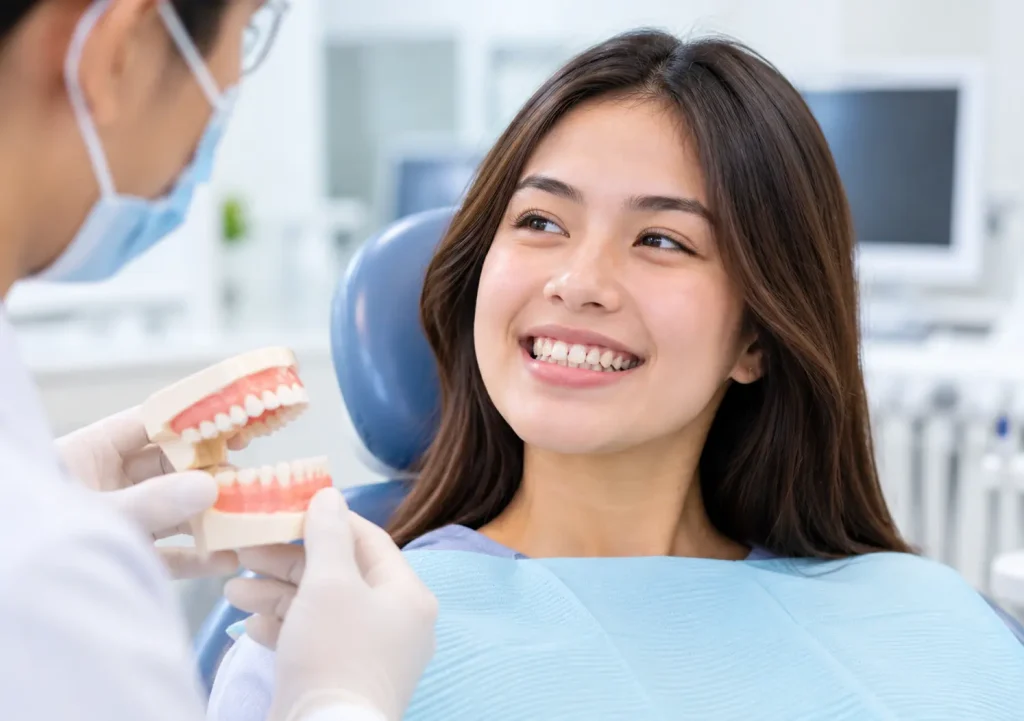
When you close your mouth, your upper front teeth should generally sit slightly in front of your lower front teeth. If your lower teeth extend beyond your upper teeth, you may have an underbite. For some people, an underbite is a minor alignment concern that doesn’t cause noticeable problems. For others, it can affect chewing, tooth wear, speech, or the way the jaw fits together. You may also feel self-conscious about the appearance of your smile.
The good news is that several underbite treatment options are available. Depending on your age, the severity of the misalignment, and whether the problem comes from your teeth or jaw structure, treatment may involve braces, clear aligners, growth-guiding appliances, or corrective jaw surgery. The important thing is to identify the cause before deciding how to correct it. A treatment that works well for a mild dental underbite may not be enough to address a significant jaw discrepancy.
In this guide, you’ll learn what causes an underbite, when treatment may be necessary, which options are available for children and adults, and how underbite treatment compares with approaches used for other bite problems, including crossbites and open bites.
What Is an Underbite?
An underbite is a type of malocclusion, which means your upper and lower teeth don’t fit together in the intended way. With an underbite, your lower front teeth sit in front of your upper front teeth when you close your mouth. This can happen because your lower jaw extends farther forward than expected, your upper jaw is positioned too far back, or your teeth are angled in a way that creates the appearance of an underbite. Some people have a combination of dental and jaw-related factors.
The distinction matters because underbite treatment depends on what’s causing the misalignment. A mild underbite caused primarily by tooth positioning may respond to orthodontic treatment alone. A more pronounced underbite involving the underlying jaw structure may require a different approach. An underbite can also occur alongside other orthodontic concerns, such as crowding, an uneven bite, or difficulty bringing your teeth together comfortably. An assessment helps your dentist understand how these issues relate to one another.
What Causes an Underbite?
Several factors can contribute to an underbite. Identifying the cause helps your dentist determine which treatment options are appropriate.
1. Genetics and Jaw Development
Jaw size and shape are strongly influenced by genetics. If members of your family have an underbite or a prominent lower jaw, you may be more likely to develop a similar bite pattern. Sometimes, the lower jaw grows more prominently than the upper jaw. In other cases, the upper jaw doesn’t develop forward as much as expected. Either situation can affect how your upper and lower teeth meet. When the underlying problem involves jaw growth, simply moving the teeth may not fully correct the discrepancy.
2. Tooth Positioning
Not every underbite is caused by a major difference in jaw size. Sometimes, the position or angle of the teeth creates the problem.
For example, your lower front teeth may lean forward, or your upper front teeth may be positioned farther back than expected. Depending on the severity and the rest of your bite, orthodontic treatment may be able to improve this type of underbite without jaw surgery. Your dentist needs to evaluate your entire bite rather than judging the condition only by the appearance of your front teeth.
3. Childhood Oral Habits
Certain childhood habits can influence how the teeth and jaws develop. Prolonged thumb-sucking, extended pacifier use, and tongue-thrusting habits may contribute to bite changes in some children. These habits do not automatically cause an underbite, and genetics and jaw development remain important factors. However, addressing persistent habits early can help support healthy oral development.
4. Dental or Jaw Injuries
Injuries affecting the teeth or jaw can sometimes change the way the upper and lower teeth fit together. If you notice a sudden change in your bite following an injury, seek a dental assessment rather than assuming it is a routine orthodontic concern.
When Should You Consider Underbite Treatment?
Not every underbite requires immediate correction. A mild case may not cause functional problems, while a more pronounced misalignment can affect your oral health and everyday comfort.
You should consider an assessment if you notice any of the following:
- Your lower front teeth sit noticeably in front of your upper teeth.
- You have difficulty biting into or chewing certain foods.
- Your teeth appear to wear unevenly.
- Your jaw feels uncomfortable when you open or close your mouth.
- You frequently bite the inside of your cheeks or lips.
- Your bite feels uneven or has changed over time.
- Your child has a developing underbite or other noticeable bite irregularity.
These signs do not necessarily mean you need orthodontic treatment or surgery. They indicate that an assessment may be helpful to determine whether the underbite is affecting your dental health or function.
If you have a child with an underbite, an early orthodontic evaluation can be particularly useful because the jaws are still developing. Identifying the problem early may provide treatment options that become more limited after growth is complete.
Underbite Treatment Options: What Works Best?
There is no single treatment that works for every underbite. Your dentist or orthodontist will consider your age, jaw development, tooth positions, bite function, and treatment goals before recommending an approach.
1. Traditional Braces
Traditional braces use brackets and wires to move teeth gradually into more appropriate positions. They can be useful when an underbite is primarily related to tooth alignment and may also be part of a more comprehensive treatment plan. Depending on your case, braces may be combined with elastics or other orthodontic appliances to help improve the relationship between your upper and lower teeth. One advantage of braces is that they remain attached to your teeth throughout treatment. You don’t have to remember to put them back in after meals, although you do need to maintain careful oral hygiene and follow your dentist’s instructions.
Braces can address many orthodontic problems, but they cannot independently correct every significant difference in jaw structure. Your treatment plan needs to account for whether the problem is dental, skeletal, or a combination of both.
2. Invisalign and Clear Aligners
Clear aligners, including Invisalign, may be suitable for some mild underbites when the required correction can be achieved through planned tooth movement.
Invisalign uses a series of custom-made, removable aligners to gradually reposition your teeth. Depending on your case, your dentist may also use attachments or elastics to support specific movements. However, Invisalign is not the right solution for every underbite. If your lower jaw is significantly forward or your upper jaw is underdeveloped, moving the teeth alone may not adequately correct the underlying problem.
Your dentist will need to assess your bite and determine whether clear aligners can realistically achieve your treatment goals. If you’re considering this option, learn more about Invisalign treatment at Stadium Dental in Downtown Vancouver. A consultation can help establish whether clear aligners are suitable for your particular alignment concerns.
3. Growth-Guiding Appliances for Children
Children whose jaws are still developing may have additional treatment options that are less applicable to adults. Depending on the cause of the underbite, an orthodontist may recommend an appliance designed to influence jaw development. For certain children with an underdeveloped upper jaw, treatment may involve an upper-jaw expander combined with reverse-pull headgear. These appliances are not appropriate for every child with an underbite. Their suitability depends on the child’s growth stage, jaw relationship, and specific orthodontic needs.
Early treatment may help improve the jaw relationship or reduce the severity of a developing problem. However, it does not guarantee that a child will avoid further orthodontic treatment later. At Stadium Dental, we provide orthodontic and Invisalign services, including treatment approaches for children. An evaluation can help determine whether early intervention may be appropriate or whether monitoring until a later stage is more suitable.
4. Corrective Jaw Surgery
When an underbite results from a significant difference in jaw structure, orthodontic treatment alone may not be enough.
Corrective jaw surgery, also called orthognathic surgery, changes the position of the upper jaw, lower jaw, or both to improve their relationship. It is generally considered when the skeletal discrepancy is substantial and cannot be adequately corrected with tooth movement alone. Treatment often involves coordination between an orthodontist and an oral and maxillofacial surgeon. Braces or aligners may be used before and after surgery to position the teeth appropriately.
Surgery is not necessary for every underbite. It is generally reserved for cases where the benefits of correcting the jaw relationship justify the procedure. If you have a pronounced underbite as an adult, a professional assessment can help clarify whether orthodontic treatment alone may be sufficient or whether a surgical consultation should be considered.
Underbite Treatment for Children vs. Adults
Your age can influence which treatment options are available, particularly when the underbite involves jaw development.
Underbite Treatment for Children
During childhood, the jaws are still growing. This can create opportunities to guide development in certain cases, depending on the cause and severity of the underbite. Early evaluation helps your dentist or orthodontist decide whether to start treatment while growth is ongoing, monitor the condition, or choose a different approach. Some children may benefit from growth-guiding appliances, followed later by braces or other orthodontic treatment. Others may not need immediate intervention. The goal is not to start treatment as early as possible in every case. It is to identify the right timing for the child’s particular needs.
Underbite Treatment for Teenagers
Teenagers may be suitable candidates for braces, clear aligners, or other orthodontic appliances, depending on their dental development and jaw relationship. If a teenager still has significant growth remaining, certain treatment approaches may be considered to address the developing jaw discrepancy. However, the available options depend on the individual case. An orthodontic assessment can help determine whether the underbite is primarily dental or skeletal and whether treatment should begin now.
Underbite Treatment for Adults
Adults can still receive effective orthodontic treatment, but their jaws have generally finished growing. If your underbite is mainly caused by tooth positioning, braces or clear aligners may improve your bite. If the discrepancy comes from a significant difference in jaw structure, corrective jaw surgery may be needed to achieve the intended result. Age alone does not determine whether treatment is possible. The important factors are the cause of the underbite, your oral health, and the degree of correction required.
What Is the Difference Between an Underbite, Crossbite, and Open Bite?
Underbites, crossbites, and open bites are all types of malocclusion, but they describe different ways your teeth may fit together. Understanding the distinction matters because each condition requires an assessment of the specific tooth positions and jaw relationship involved.
Underbite
An underbite occurs when your lower front teeth sit in front of your upper front teeth. The cause may involve tooth positioning, jaw development, or both. Treatment may include braces, clear aligners for suitable cases, growth-guiding appliances for certain children, or corrective jaw surgery for significant skeletal discrepancies.
Crossbite
A crossbite occurs when one or more upper teeth sit inside the corresponding lower teeth when you bite down, rather than outside them as expected. A crossbite can affect the front teeth, back teeth, or both. Depending on its cause, treatment may involve braces, clear aligners, an expander, or other orthodontic appliances. The appropriate crossbite treatment depends on whether the problem comes from tooth positioning, jaw width, or a combination of factors. The condition should be evaluated rather than treated based on appearance alone.
Open Bite
An open bite occurs when certain upper and lower teeth do not meet when you close your mouth. For example, you may have a visible gap between your front teeth even when your back teeth are together. An open bite may be associated with jaw development, tooth positioning, or habits such as prolonged thumb-sucking or tongue thrusting. Depending on the cause and severity, open bite correction may involve braces, clear aligners for suitable cases, habit management, or other orthodontic treatment. Some more complex skeletal cases may require surgical correction. Although these conditions can sometimes occur together, they are not interchangeable. Your dentist needs to identify the specific bite problem before recommending treatment.
What Happens If You Don’t Treat an Underbite?
Whether an underbite needs treatment depends on its severity and how it affects your teeth, bite, and everyday function. A mild underbite may not cause noticeable problems and may only require monitoring. However, a more pronounced underbite can create challenges over time.
Uneven Tooth Wear
When your teeth do not meet properly, certain teeth may experience more pressure than others. This can contribute to uneven wear or damage, particularly if the bite places excessive force on specific teeth.
Difficulty Biting and Chewing
Your front teeth help you bite into food, while your back teeth play a major role in chewing. An underbite can interfere with these functions, depending on the extent of the misalignment.
Increased Difficulty Cleaning Certain Areas
Crowded or overlapping teeth can create areas that are harder to clean effectively. If plaque accumulates, the risk of tooth decay and gum disease may increase. An underbite itself does not automatically cause these conditions, but maintaining good oral hygiene and attending regular dental checkups remain important.
Jaw Discomfort
Some people with an underbite experience jaw discomfort or difficulty moving their jaw comfortably. However, an underbite does not automatically mean you will develop a temporomandibular joint disorder. If you have persistent jaw pain, difficulty opening your mouth, or a sudden change in your bite, seek a dental assessment to identify the cause. The decision to pursue underbite treatment should be based on your individual condition rather than assuming every underbite will worsen or lead to complications.
How Long Does Underbite Treatment Take?
The length of treatment depends on the severity of the underbite, the underlying cause, your age, and the approach used. Some relatively mild dental underbites may be improved with orthodontic treatment over several months to a year or longer. More involved cases may require a longer period of braces or aligner treatment. If jaw surgery is needed, treatment generally takes longer because orthodontic preparation, surgery, healing, and follow-up orthodontic care may all be involved.
Children receiving growth-guiding treatment may also need additional orthodontic treatment as their permanent teeth erupt and their jaws continue to develop. Your dentist or orthodontist can provide a more realistic estimate after evaluating your bite and developing a treatment plan. Your actual timeline may change if your teeth do not move as expected or if additional correction is needed.
Following your treatment instructions and attending scheduled appointments can help your provider monitor progress and address problems when they arise.
How Much Does Underbite Treatment Cost?
The cost of underbite treatment depends on the complexity of your case and the type of treatment required. Braces and clear aligners generally involve different costs from corrective jaw surgery. Treatment involving expanders, additional appliances, or several phases of orthodontic care may also affect the overall expense. Other factors can include the length of treatment, the number of aligners required, follow-up appointments, and whether retainers or additional refinements are included in the quoted fee.
Before beginning treatment, ask your provider for a breakdown of the expected costs and what is included. If surgery is being considered, clarify which services are provided by the orthodontic team and which may be billed separately by the surgical provider or hospital.
At Stadium Dental, you can review the clinic’s Invisalign pricing information if clear aligners may be suitable for your case. Keep in mind that this pricing applies to Invisalign treatment and does not represent the cost of every possible underbite treatment.
Underbite Treatment at Stadium Dental in Vancouver
If you’re concerned about the way your teeth fit together, the first step is to understand what’s causing the underbite and whether treatment would benefit your oral health or function.
At Stadium Dental in Downtown Vancouver, patients can explore orthodontic options, including traditional braces and Invisalign. The clinic also offers orthodontic care for children, which can be important when evaluating bite problems during growth and development. During an assessment, your dentist can evaluate your tooth alignment, discuss your concerns, and determine whether the problem may be addressed with orthodontic treatment or requires further specialist evaluation.
Not every underbite can be corrected with clear aligners, and more significant jaw discrepancies may require referral to an appropriate specialist. Understanding those limitations helps you make an informed decision about your next steps.
Concerned about your bite? Contact Stadium Dental to arrange an appointment and discuss your orthodontic concerns with the dental team.
Frequently Asked Questions About Underbite Treatment
1. Can an underbite be corrected without surgery?
Yes, some underbites can be improved without surgery, particularly when the problem is mainly related to tooth positioning or is suitable for orthodontic treatment during growth. More significant skeletal underbites may require corrective jaw surgery. Your dentist or orthodontist can assess which approach is appropriate.
2. Can Invisalign fix an underbite?
Invisalign may help correct certain mild underbites when the necessary changes can be achieved through tooth movement. However, it cannot independently correct every significant jaw discrepancy. An assessment is necessary to determine whether clear aligners can meet your treatment goals.
3. What is the best age to start underbite treatment?
There is no single ideal age for every patient. An early orthodontic evaluation during childhood can help identify jaw-development concerns while growth is ongoing. The appropriate time to begin treatment depends on the cause of the underbite, the child’s development, and the type of correction needed.
4. Does an underbite get worse with age?
An underbite does not necessarily worsen in every person. However, jaw growth, tooth movement, and changes in dental health can affect how your bite develops over time. If you notice a new or worsening bite problem, arrange a dental assessment.
5. What is the difference between an underbite and a crossbite?
An underbite generally describes a relationship in which the lower front teeth sit ahead of the upper front teeth. A crossbite occurs when one or more upper teeth sit inside the corresponding lower teeth. They are different bite problems, although they can occur together.
6. What is the difference between an underbite and an open bite?
With an underbite, the lower front teeth sit in front of the upper front teeth. With an open bite, certain upper and lower teeth do not touch when you close your mouth. Each condition requires a different assessment and may need a different treatment approach.
7. Can adults get underbite treatment?
Yes. Adults can receive orthodontic treatment for underbites, including braces or clear aligners when appropriate. If the problem involves a significant jaw discrepancy, corrective jaw surgery may be considered. The right approach depends on your dental health, bite, and treatment goals.
8. Does every underbite need treatment?
No. Some mild underbites do not cause functional problems and may only need monitoring. More pronounced cases may affect chewing, tooth wear, or jaw comfort. Your dentist can help determine whether treatment is necessary or whether observation is appropriate.
Conclusion: Find the Right Underbite Treatment for Your Smile
Underbite treatment depends on more than how your teeth look when you smile. The cause of the misalignment, your age, jaw development, and the way your teeth meet all influence which treatment is likely to work. For some patients, braces or clear aligners may be sufficient. Children with certain jaw-development concerns may benefit from early orthodontic appliances, while significant skeletal underbites may require corrective jaw surgery. Related bite problems, including crossbites and open bites, also need to be evaluated individually because their causes and treatment requirements can differ. If you or your child has an underbite, a dental assessment can help clarify the available options and whether treatment is recommended. Stadium Dental in Downtown Vancouver can help you explore orthodontic care and understand the next steps for your situation.