
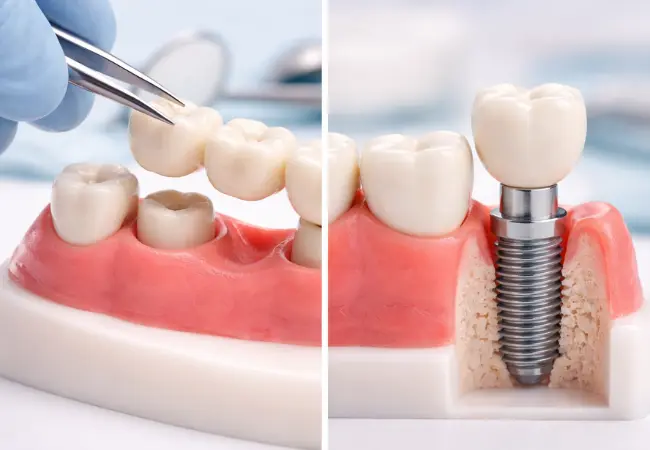
If you are missing a tooth, one of the biggest questions you will face is this: Should you get a dental bridge or an implant? It is a smart question, because both treatments can replace missing teeth, restore your smile, and improve chewing. But they are not the same, and the better option depends on your mouth, your goals, and your budget. When you compare a dental bridge vs. implant, you are really comparing two different ways to solve the same problem. A bridge fills the gap by attaching to nearby teeth or implants, while a dental implant replaces the missing tooth root and supports a crown, bridge, or denture on top.
That difference matters more than most people realize. One option may be faster and cost less upfront. The other may last longer and preserve more bone over time. If you choose based only on price or only on what sounds more advanced, you can make the wrong call for your situation.
What is a dental bridge?
A dental bridge is a fixed tooth replacement that fills the gap left by one or more missing teeth. It is usually supported by the teeth on either side of the space, although dental implants can also support some bridges.
If you are missing one tooth and the adjacent teeth are healthy, a traditional bridge may be a good option. It can help restore your smile and make chewing easier. Since it stays in place, you do not remove it like a denture.
What is a dental implant?
A dental implant is a surgical tooth replacement option that places a post in your jawbone to support an artificial tooth. Once it heals, the implant can function as the foundation for a crown, a bridge, or even a denture. Implants are a common surgical replacement option that can be used much like a natural tooth after healing.
When people search for the best tooth replacement option, implants often come up first because they are designed to replace the tooth root, not just the visible part of the tooth.
Dental bridge vs. implant: the core difference
The simplest way to think about this comparison is structure. A bridge spans the gap and depends on support from surrounding teeth or implants. A single implant stands on its own by anchoring directly into the jawbone. That means a traditional bridge usually involves preparing the teeth next to the gap, while an implant generally does not use neighboring teeth for support.
This is why the question is not just “which one replaces the tooth?” Both do that. The better question is “how do they replace it, and what does that mean for the rest of your mouth?”
When a dental bridge may be the better option
A bridge may be the better choice if you want a treatment that is generally faster, less invasive, and lower in upfront cost than an implant. Bridges tend to cost less than implants, and also do not require drilling into the jawbone, and are usually less expensive.
A bridge may also make more sense if the teeth next to the gap already need crowns anyway. In that case, using those teeth as support may be more reasonable than it would be if they were completely untouched and healthy. That is not a universal rule, but it is a common clinical logic behind choosing a bridge. This is an inference based on how traditional bridges work and how they rely on crowned adjacent teeth.
If you are missing more than one tooth in a row, a bridge can also be a practical solution, especially when a separate implant for each tooth would be too costly or not ideal.
When a dental implant may be the better option
An implant may be the better choice if you want the replacement that behaves most like a natural tooth and does not depend on neighboring teeth for support. Implants last longer than bridges in general, and ADA patient guidance presents implants as a strong, long-term replacement option.
Implants also help preserve the bone in the area of the missing tooth. If you are replacing a single missing tooth and the teeth next to the space are healthy, an implant often makes more strategic sense because it leaves those teeth alone.
Dental bridge vs. implant cost
Cost is one of the biggest reasons patients hesitate. In general, a dental bridge usually costs less up front than a dental implant. But cheaper upfront does not always mean cheaper long term. Bridges are usually less durable than implants and may need replacement sooner. Moreover, bridges are less durable and harder to clean, while implants generally last longer. So the cost question should not be “which is cheaper today?” It should be “which makes the most financial and clinical sense over time?”
Dental bridge vs. implant lifespan
A bridge can last for years, but implants usually last longer. Bridges can last about five to 15 years on average, while implants can last a lifetime with proper care once healing is complete. That does not mean every implant lasts forever, or every bridge fails early, but it does mean implants usually win on long-term durability.
This matters if you are younger, if the missing tooth is in a high-function area, or if you want to minimize the chance of replacing the restoration again later.
Dental bridge vs. implant cleaning and maintenance
Both options require care, but they are not maintained in exactly the same way.
A single tooth implant is usually easier to keep clean than a bridge. A traditional bridge can create a harder-to-clean area under the pontic and around the supporting teeth, which means your home care routine matters a lot.
This is not a small point. If your brushing and cleaning habits are inconsistent, a bridge may place more demands on you than you expect. A treatment is only “better” if you can realistically maintain it.
Dental bridge vs. implant procedure time
A bridge is often the faster option.
An implant usually requires surgery and healing, and from start to finish, it can take as long as six months and multiple visits to complete an implant and crown. A bridge, by contrast, is typically a more straightforward restorative process with fewer treatment stages.
So if speed is one of your top concerns, that may push the decision toward a bridge. If long-term independence and bone support matter more, that may push the decision toward an implant.
What we discuss with patients at Stadium Dental
At Stadium Dental, we help patients compare bridges and implants based on what actually makes sense for their mouth, not based on a one-size-fits-all answer. We offer crowns and bridges, dental implants, dentures, and other restorative treatments, so when you come to us with a missing tooth, we can look at more than one option.
When we evaluate a bridge vs. implant case, we look at the gap itself, the health of the teeth beside it, your bite, your bone support, your long-term goals, and your budget. In some cases, a traditional bridge is the more practical solution. In others, an implant gives you a better long-term outcome. We also offer digital treatment planning, transparent implant pricing information, and free implant consultations to help you explore your options clearly before committing.
Our goal is not to push one treatment because it sounds more advanced. Our goal is to help you choose the tooth replacement option that is functional, realistic, and right for your situation.
So, which is better: a dental bridge or an implant?
The honest answer is this: an implant is often the better long-term option, while a bridge is often the better short-term or lower-cost option. That is the tradeoff in most cases.
- If you want a faster, less expensive treatment and the neighboring teeth can support it well, a bridge may be the better fit.
- If you want the replacement that usually lasts longer, preserves bone, and avoids using adjacent teeth as anchors, an implant may be the better fit.
The mistake is thinking there is one correct answer for everyone. There is not. There is only one option that makes the most sense for your case.
FAQ: Dental bridge vs. implant
Is a dental implant better than a bridge?
Often, yes, for long-term durability and bone preservation. But a bridge may still be the better choice if you want a lower upfront cost, faster treatment, or if implant surgery is not ideal for you.
Is a bridge cheaper than an implant?
Yes, in most cases, a bridge costs less up front than an implant.
Do implants last longer than bridges?
Yes. Bridges often last around five to 15 years, while implants can last much longer and may last a lifetime with proper care.
Which is easier to clean, a bridge or an implant?
A single tooth implant is generally easier to keep clean than a bridge.
Is a bridge better if you are missing several teeth?
It can be. If you are missing more than one consecutive tooth, a bridge may be more practical than placing a separate implant for each missing tooth. Another option may be an implant-supported bridge.
Does an implant involve surgery?
Yes. Dental implants are a surgical tooth replacement option and usually involve a healing time before the final crown is placed.
Conclusion
If you are comparing a dental bridge vs. implant, you should not ask which one is universally better. You should ask which one fits your mouth, your priorities, and your long-term plan.
A bridge can be faster, more affordable upfront, and highly effective in the right case. An implant can be more independent, longer-lasting, and better for bone preservation. Both can work well. The right answer depends on your specific situation.