
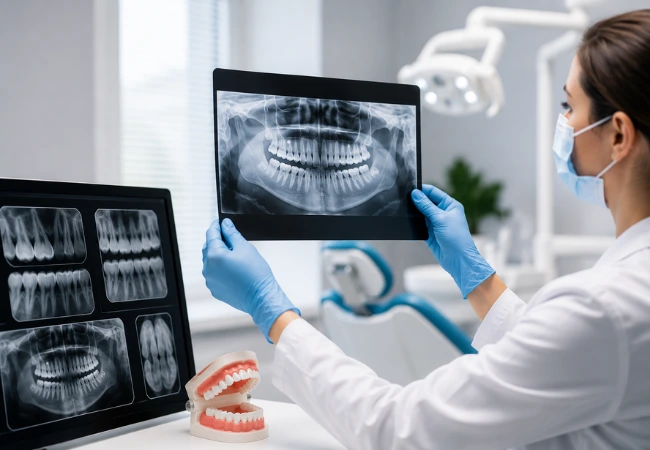
Dental X-rays help your dentist see what cannot always be seen during a regular visual exam. Even if your teeth look healthy from the outside, there may be decay between teeth, bone loss, infection near the root, impacted teeth, or problems developing below the gums. The important thing to understand is this: not all dental X-rays are the same. Different types of dental X-rays show different parts of your teeth, jaw, bone, and surrounding structures. Your dentist chooses the type of X-ray based on what they need to check, not just as a routine step.
Below, we’ll explain the main types of dental X-rays, what each one is used for, and why your dentist may recommend one during your visit.
What Are Dental X-Rays?
Dental X-rays, also called dental radiographs, are images that help dentists diagnose oral health problems that may not be visible during a standard exam. They can show tooth decay, bone levels, infection, tooth development, impacted teeth, and other issues below the surface. X-rays are often used during routine exams, emergency visits, orthodontic evaluations, root canal assessments, wisdom tooth evaluations, and treatment planning.
Your dentist may recommend X-rays based on:
- Your age
- Your oral health history
- Your cavity risk
- Your gum health
- Your symptoms
- Your previous dental work
- The type of treatment being planned
- How long has it been since your last dental images
There is no single schedule that fits everyone. A patient with frequent cavities may need X-rays more often than someone with excellent oral health and low risk.
The Main Types of Dental X-Rays
1. Bitewing X-Rays
Bitewing X-rays are one of the most common types of dental X-rays. They show the upper and lower teeth in one area of your mouth, usually the back teeth. They are called bitewing X-rays because you bite down on a small holder while the image is taken.
Bitewing X-rays are useful for checking:
- Cavities between teeth
- Early tooth decay that is not visible during an exam
- Decay under or around old fillings
- Changes in bone levels caused by gum disease
- How crowns, fillings, or bridges fit
Bitewing X-rays are especially helpful because cavities often start between teeth. These areas are difficult to see with the naked eye, even during a careful dental exam.
When your dentist may recommend bitewing X-rays
Your dentist may recommend bitewing X-rays during a routine checkup, especially if you have a history of cavities, tooth sensitivity, deep grooves in your molars, or old dental restorations that need monitoring.
2. Periapical X-Rays
Periapical X-rays focus on one or a few teeth at a time. Unlike bitewing X-rays, they show the entire tooth from the crown down to the root tip and surrounding bone.
Periapical X-rays may be used to check:
- Tooth roots
- Abscesses or infections
- Bone loss around a tooth
- Deep decay
- Cracked or injured teeth
- Root canal concerns
- Problems near the tip of the tooth root
This type of X-ray is often used when a patient has pain in a specific tooth. It helps the dentist look beyond the visible crown and assess what is happening below the gumline.
When your dentist may recommend bitewing X-rays
Your dentist may recommend a periapical X-ray if you have a toothache, swelling, trauma, a suspected infection, or a tooth that may need root canal treatment.
3. Panoramic X-Rays
A panoramic X-ray shows the entire mouth in one wide image. It captures the upper and lower teeth, jawbone, jaw joints, sinuses, and surrounding structures. Instead of placing the X-ray sensor inside your mouth, a panoramic machine rotates around your head while you stand or sit still.
Panoramic X-rays are useful for checking:
- Wisdom teeth
- Impacted teeth
- Missing or extra teeth
- Jaw development
- Large infections or cysts
- Jaw joint concerns
- Overall tooth position
- Orthodontic treatment planning
A panoramic X-ray does not usually show tiny cavities as clearly as bitewing X-rays. Its strength is that it gives your dentist a broad view of the full mouth and jaw.
When your dentist may recommend panoramic X-rays
Your dentist may recommend a panoramic X-ray if you are being evaluated for wisdom teeth, orthodontic treatment, jaw concerns, dental implants, or a general overview of your oral structures.
4. Occlusal X-Rays
Occlusal X-rays show a larger section of either the upper or lower jaw. They are often used to check tooth development, especially in children. This type of X-ray can show the floor and roof of the mouth and teeth that have not yet erupted.
Occlusal X-rays may help detect:
- Impacted teeth
- Extra teeth
- Missing teeth
- Jaw fractures
- Cysts or growths
- Tooth development in children
- Teeth that have not come through the gums
When your dentist may recommend occlusal X-rays
A dentist may recommend an occlusal X-ray when checking how a child’s teeth are developing or when a tooth is not erupting as expected.
5. Cephalometric X-Rays
A cephalometric X-ray, often called a ceph X-ray, shows a side view of the head, jaw, teeth, and facial bones. It is commonly used in orthodontics.
Cephalometric X-rays can help evaluate:
- Jaw position
- Bite alignment
- Facial growth patterns
- Tooth angle and position
- Orthodontic treatment needs
- Relationship between upper and lower jaws
This type of X-ray is not usually taken during a basic dental exam. It is more common when braces, aligners, or jaw growth concerns are being evaluated.
When your dentist may recommend cephalometric X-rays
A cephalometric X-ray may be recommended before orthodontic treatment or when assessing bite problems, jaw alignment, or facial growth.
6. Cone Beam CT Scan, or CBCT
A cone beam CT scan is a 3D dental imaging scan. Unlike standard 2D dental X-rays, CBCT creates a three-dimensional view of teeth, jawbone, nerves, sinuses, and other structures.
CBCT scans may be used to assess:
- Dental implant placement
- Bone density and bone volume
- Impacted teeth
- Complex root canal anatomy
- Jawbone condition
- Nerve location
- Sinus position
- Complex extractions
CBCT is more detailed than regular dental X-rays, but it is not needed for every patient. It is typically used when a dentist needs more advanced imaging for diagnosis or treatment planning.
When your dentist may recommend a CBCT scan
Your dentist may recommend CBCT for dental implants, complicated extractions, advanced root canal cases, impacted teeth, or when a 2D image does not provide enough information.
7. Full Mouth Series X-Rays
A full mouth series is a complete set of dental X-rays that usually includes bitewing and periapical images. Instead of one image, it gives the dentist a detailed view of all teeth and supporting bone.
A full mouth series can help assess:
- Cavities
- Bone levels
- Tooth roots
- Past dental work
- Gum disease concerns
- Abscesses or infections
- Overall dental health
When your dentist may recommend a full mouth series
A full mouth series may be recommended for new patients, patients with complex dental histories, signs of gum disease, multiple dental concerns, or before major treatment planning.
Which Type of Dental X-Ray Do You Need?
The right type of dental X-ray depends on the reason for your visit. If your dentist is checking for cavities between your back teeth, bitewing X-rays may be recommended. If you have pain in one tooth, a periapical X-ray may be better. If wisdom teeth are being evaluated, a panoramic X-ray may be more useful. If implants or complex treatment planning are involved, CBCT may be considered.
The main point is that X-rays should match the clinical question. A good dentist does not take every possible image for every patient. They choose the image that gives the needed information.
Are Dental X-Rays Safe?
Dental X-rays use a low level of radiation, and modern digital imaging helps keep exposure as low as reasonably achievable. This explains that X-rays should be selected based on a patient’s individual needs, oral health, age, disease risk, and symptoms rather than a one-size-fits-all schedule.
Dentists also use safety principles such as choosing the right image for the situation, limiting the beam to the area of interest, and adjusting exposure for children when needed. If you are pregnant, have had recent X-rays elsewhere, or are concerned about radiation exposure, tell your dental team before imaging is taken.
Dental Exams and X-Rays at Stadium Dental in Downtown Vancouver
If you are looking for dental exams and X-rays in Downtown Vancouver, Stadium Dental offers diagnostic care designed to help detect oral health concerns early and support accurate treatment planning.
At Stadium Dental, exams and X-rays are used to better understand your teeth, gums, bone levels, and overall oral health before recommending treatment. Our clinic highlights advanced diagnostics, comprehensive care, and a comfortable setting for patients. We also use low-radiation X-rays and modern technology as part of its commitment to precise and comfortable care.
Whether you are visiting for a routine exam, tooth sensitivity, a possible cavity, wisdom tooth concerns, or a second opinion, dental X-rays can help the team see what is happening below the surface and recommend the right next step.
When Should You Get Dental X-Rays?
You may need dental X-rays if:
- You are a new patient
- You have tooth pain or sensitivity
- Your dentist suspects a cavity
- You have swelling or signs of infection
- You have gum disease concerns
- You need a wisdom tooth evaluation
- You are planning orthodontic treatment
- You are considering dental implants
- You have old fillings, crowns, or bridges that need checking
- You have had dental trauma
You may not need X-rays at every visit. Your dentist should recommend them based on your current oral health, symptoms, history, and risk level.
FAQs About Types of Dental X-Rays
What are the most common types of dental X-rays?
The most common types of dental X-rays are bitewing, periapical, panoramic, occlusal, cephalometric, CBCT, and full mouth series X-rays.
What type of dental X-ray shows cavities?
Bitewing X-rays are commonly used to detect cavities between teeth. These areas are difficult to see during a visual dental exam.
What type of X-ray is used for wisdom teeth?
A panoramic X-ray is often used to evaluate wisdom teeth because it shows the entire mouth, jaw, and tooth position in one image.
What is the difference between bitewing and periapical X-rays?
Bitewing X-rays show the upper and lower teeth in one area and are often used to detect cavities between teeth. Periapical X-rays show the entire tooth from crown to root and are often used to check infections, root problems, and bone around a specific tooth.
Are dental X-rays needed at every dental visit?
Not always. Dental X-rays should be recommended based on your oral health, age, symptoms, cavity risk, gum health, and treatment needs.
What is a CBCT dental scan?
A CBCT dental scan is a 3D dental image that shows teeth, bone, nerves, sinuses, and jaw structures. It is often used for dental implants, complex extractions, impacted teeth, and advanced treatment planning.
Conclusion
There are several types of dental X-rays, and each one has a specific purpose. The best type of dental X-ray depends on what your dentist needs to diagnose or plan. If you are unsure why an X-ray is being recommended, ask your dentist to explain what they are looking for and how the image will help guide your care.
At Stadium Dental in Downtown Vancouver, dental exams and X-rays help the team detect issues early, plan treatment accurately, and support long-term oral health.