
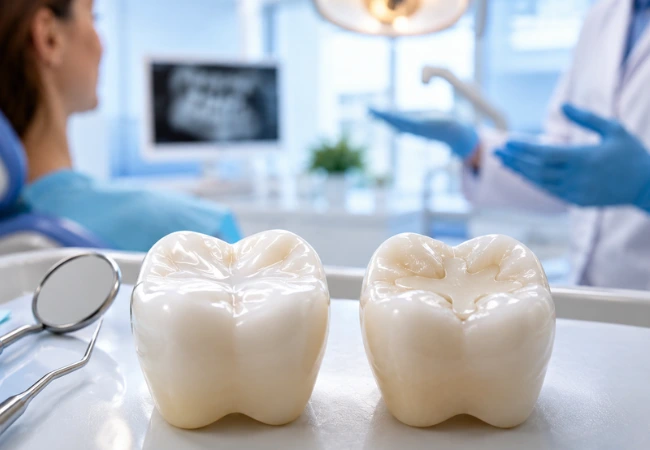
Dental sealants and fillings both help protect teeth, but they are not the same treatment. The simplest way to understand the difference is this: sealants help prevent cavities, while fillings repair teeth after decay has already caused damage. That difference matters. If a tooth is healthy but has deep grooves that trap food and bacteria, a dental sealant may help protect it. If a cavity has already formed, a filling is usually needed to restore the tooth.
In this guide, we’ll explain dental sealants vs. fillings in clear terms, including what each treatment does, when dentists recommend them, how they are placed, and which option may be right for you or your child.
What Are Dental Sealants?
Dental sealants are thin protective coatings placed on the chewing surfaces of the back teeth, usually the molars and premolars. These teeth often have small pits and grooves that are difficult to clean with a toothbrush.
Even if you brush well, food particles and bacteria can settle into these grooves. Over time, that can lead to cavities. A sealant covers those hard-to-clean areas and creates a smoother surface that is easier to keep clean. Moreover, sealants are most commonly used for children and teenagers, especially when permanent molars first come in. However, some adults may also benefit from sealants if their back teeth have deep grooves and no existing decay.
What Are Dental Fillings?
Dental fillings are restorative treatments used when a tooth has already been damaged by decay, fracture, or wear. If a cavity has formed, the dentist removes the decayed part of the tooth, cleans the area, and fills the space with dental material. Also, it will help restore the tooth’s shape, strength, and function. They also help prevent the cavity from getting deeper.
Common filling materials include:
- Composite resin
- Amalgam
- Glass ionomer
- Porcelain inlays or onlays
- Gold
Composite resin, often called a white filling or tooth-colored filling, is commonly used because it can blend with the natural shade of your tooth.
The Main Difference: Prevention vs. Repair
The biggest difference between dental sealants and fillings is the reason they are used. Sealants are preventive. They are placed before a cavity forms. The goal is to block food, plaque, and bacteria from settling into deep grooves in the back teeth. On the other hand, fillings are restorative. They are placed after a cavity or damaged area exists. The goal is to remove decay and rebuild the missing tooth structure.
This is where many patients get confused. A sealant cannot replace a filling if the tooth already has a formed cavity. A filling cannot prevent grooves from trapping bacteria in the same simple way a sealant does. They each have a different job.
When Would a Dentist Recommend Sealants?
A dentist may recommend sealants when a tooth is healthy but at risk for cavities.
Sealants may be recommended if:
- A child’s permanent molars have recently erupted
- The back teeth have deep grooves or pits
- Food often gets stuck in the chewing surfaces
- A child has a history of cavities
- A patient has difficulty cleaning the molars well
- The tooth has early enamel weakening but no formed cavity
- The dentist wants to reduce future cavity risk
Sealants are especially common around the ages when permanent molars come in. First permanent molars often erupt around age 6, and second permanent molars often erupt around age 12.
When Would a Dentist Recommend Fillings?
A dentist may recommend a filling when decay has already damaged the tooth.
Fillings may be recommended if:
- A cavity has formed
- A tooth has a small fracture
- An old filling is loose, cracked, or worn
- Decay is found around an existing restoration
- A tooth has minor damage from wear
- A tooth is sensitive because of an exposed or weakened structure
The goal of a filling is to stop the decay from spreading and restore the tooth before the problem becomes more serious. If decay is ignored, the tooth may eventually need a crown, root canal, or extraction.
Which Lasts Longer: Sealants or Fillings?
Sealants can last for years, but they need to be checked at regular dental visits. If a sealant chips, wears down, or comes loose, your dentist may repair or replace it. Fillings can also last for years, but their lifespan depends on the material, cavity size, tooth location, bite pressure, oral hygiene, and whether you grind your teeth. Neither treatment is permanent forever. Both need monitoring.
Which Costs More: Sealants or Fillings?
In many cases, sealants cost less than fillings because they are preventive, non-invasive, and simpler to place. Fillings usually cost more because they involve removing decay, restoring tooth structure, and using more clinical time. However, cost depends on the clinic, tooth, material, insurance coverage, and the complexity of the treatment.
From a prevention standpoint, sealants can be a smart investment because they may reduce the risk of needing fillings later. But they only help when used at the right time, before a cavity becomes more serious.
Dental Sealants and Fillings at Stadium Dental in Downtown Vancouver
At Stadium Dental here in Downtown Vancouver, preventive and restorative dental care are both part of helping patients maintain healthier smiles.
For children, we focus on early prevention, education, and comfortable visits. We have a fun, stress-free environment and personalized care to help keep your children’s teeth strong as they grow. For patients who already have cavities, we provide dental fillings designed to restore tooth strength and blend naturally with your smile. The clinic’s dental fillings page describes the service as cavity treatment using materials that blend with natural teeth.
If you are unsure whether you or your child needs sealants, fillings, or another preventive treatment, Stadium Dental can examine the teeth, explain the options clearly, and recommend the right next step based on what is actually happening in the mouth.
FAQs About Dental Sealants vs. Fillings
What is the main difference between dental sealants and fillings?
The main difference is purpose. Dental sealants help prevent cavities, while fillings repair teeth that already have decay or damage.
Are sealants better than fillings?
Sealants are better for prevention. Fillings are better for repairing a tooth after a cavity has formed. One is not better than the other in every situation because they solve different problems.
Can sealants fix cavities?
Sealants cannot fix formed cavities. If decay has already created a hole in the tooth, a filling is usually needed. Sealants are mainly used before a cavity develops.
Are dental sealants only for kids?
No. Sealants are most common for children and teenagers, but some adults with deep grooves and no existing decay may also benefit from them.
Do fillings prevent future cavities?
Fillings repair existing cavities, but they do not make the tooth immune to future decay. You can still get decay around or near a filling if plaque and bacteria build up.
Should my child get sealants or fillings?
If your child’s molars are healthy but cavity-prone, sealants may be recommended. If your child already has a cavity, a filling may be needed. A dental exam is the only way to know for sure.
Conclusion
Dental sealants and fillings both protect your oral health, but they are used at different stages. Sealants are preventive. They are placed on healthy or at-risk back teeth to help block food, plaque, and bacteria from deep grooves. Fillings are restorative. They repair teeth after decay or damage has already occurred. If the tooth does not have a cavity, a sealant may help prevent one. If the tooth already has a cavity, a filling is usually needed to restore it.
At Stadium Dental in Downtown Vancouver, the team can assess your teeth or your child’s teeth and explain whether sealants, fillings, or another treatment is the right choice.