
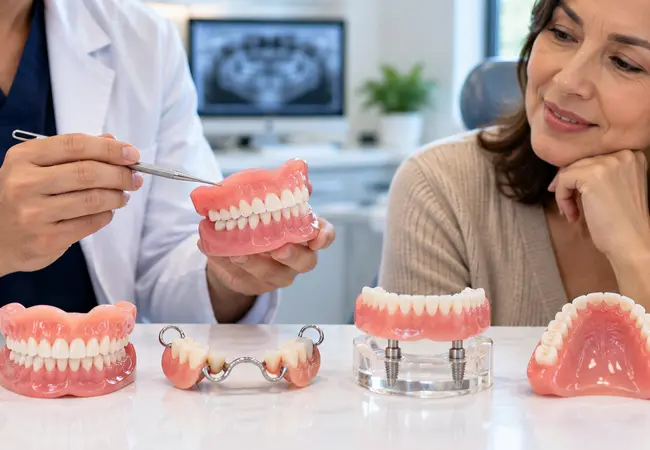
Missing teeth can make it harder to eat, speak clearly, and feel confident when you smile. Dentures are one of the most common ways to fix that. But once you start looking into them, you’ll quickly find there’s more than one kind.
This guide explains the main types of dentures in plain language. You’ll learn how each one works, who it’s best for, and what to think about so you can choose the option that fits your mouth, your lifestyle, and your budget.
What Are Dentures?
Dentures are removable or fixed replacement teeth. They’re custom-made to fit your mouth and look like natural teeth and gums.
Most dentures have two parts:
- The teeth, usually made of acrylic (a strong type of plastic) or porcelain
- The base, which looks like gum tissue and holds the teeth in place
Dentures can replace a few missing teeth or a whole set, on the top, the bottom, or both.
The Main Types of Dentures
1. Complete (Full) Dentures
Best for: people who are missing all of their teeth on the top, the bottom, or both.
Complete dentures replace a full arch of teeth. They rest on your gums. The upper denture covers the roof of your mouth, which helps it stay in place through suction. The lower denture is shaped like a horseshoe to leave room for your tongue.
Pros:
- Restores your full smile
- Supports your cheeks and lips, so your face looks fuller
- Lower upfront cost than implant options
Cons:
- Can move or slip, especially the lower denture
- May take time to get used to eating and speaking
- Needs to be adjusted or relined over time as your gums and jawbone change
2. Immediate Dentures
Best for: people who are having their remaining teeth removed and don’t want to go without teeth while they heal.
Immediate dentures are made before your teeth are removed. They’re placed on the same day as your extractions, so you never have to leave the clinic without teeth.
Pros:
- You’re never without teeth
- They protect your gums while they heal
- They help you get used to wearing dentures sooner
Cons:
- Your gums shrink as they heal, so the denture will loosen
- They usually need several adjustments or a reline
- Many people eventually replace them with a permanent denture
If you’re facing extractions, our article on the risks of tooth extraction explains what to expect and how to heal well.
3. Partial Dentures
Best for: people who still have some healthy natural teeth.
A partial denture fills in the gaps where teeth are missing. It usually attaches to your natural teeth with small clasps. It also helps stop your remaining teeth from shifting into the empty spaces.
There are a few kinds of partial dentures:
- Metal-framework partials. These have a thin, strong metal base. They’re durable, secure, and less bulky, which makes them a common long-term choice.
- Acrylic partials. These are made of plastic and are usually more affordable. They’re often used as a temporary option while you heal or plan other treatment.
- Flexible partials. These are made of a bendable material. They’re comfortable and have no metal clasps, but they can be harder to adjust or repair later.
Pros:
- Keeps your natural teeth
- Less expensive than implants or bridges in many cases
- Easy to remove and clean
Cons:
- Clasps may show when you smile
- Can put some pressure on the teeth they attach to
- Still removable, so they can feel less stable than fixed options
4. Implant-Supported Dentures
Best for: people who want dentures that feel more secure and don’t slip.
Implant-supported dentures attach to dental implants, which are small posts placed in your jawbone. The implants act like anchors, so the denture stays firmly in place.
There are two main kinds:
- Snap-in dentures (overdentures). These clip onto two or more implants. You can remove them at night to clean them. They’re much more stable than regular dentures, especially on the lower jaw.
- Fixed implant dentures. These are attached permanently, and only your dentist can remove them. One well-known option is All-on-4, where a full arch of teeth is supported by four implants. Learn more in our guide to All-on-4 dental implants in Vancouver.
Pros:
- Won’t slip when you eat or talk
- Lets you chew more foods with confidence
- Helps protect your jawbone from shrinking
- Upper implant dentures often don’t need to cover the roof of your mouth, so food tastes more natural
Cons:
- Higher cost
- Requires surgery and healing time
- You need enough healthy jawbone, or a bone graft first
Wondering about the investment? Our article on how much dental implants cost in Canada explains what affects the price.
How to Choose the Right Type of Denture
The best denture for you depends on a few things:
- How many teeth you’re missing. Missing a few teeth usually points to a partial. Missing all of them points to a complete or implant denture.
- The health of your remaining teeth and gums. Healthy teeth can often be kept and used to support a partial. If gum disease is a concern, read our guide on periodontal disease.
- Your jawbone. Implant dentures need enough bone to hold the implants.
- Your budget and coverage. Traditional dentures cost less upfront. Implant options cost more but often feel and work better.
- Your lifestyle. If you speak often at work, love crunchy foods, or hate the idea of your teeth moving, a more stable option may be worth it.
Dentures aren’t your only option either. Bridges and single implants may also work, depending on your situation. Compare them in our guide to the best tooth replacement options after extraction.
What to Expect When Getting Dentures
Getting dentures usually takes a few visits:
- Exam and planning. Your dentist checks your mouth, takes X-rays, and talks with you about your options.
- Impressions or scans. Your dentist records the shape of your mouth so your denture fits properly.
- Try-in. You may try a model of your denture to check the fit, the bite, and how the teeth look.
- Final fitting. You receive your finished denture, and your dentist makes any small adjustments.
- Follow-up visits. Sore spots are common at first. Short adjustment visits help make your denture more comfortable.
Tips for Getting Used to New Dentures
It’s normal for new dentures to feel strange at first. Most people adjust within a few weeks. These tips can help:
- Start with soft foods cut into small pieces.
- Chew on both sides of your mouth at the same time to keep your denture balanced.
- Practise speaking by reading out loud.
- Report sore spots to your dentist instead of putting up with them.
- Take your denture out at night (unless it’s fixed) to give your gums a rest.
- Clean it every day and keep it in water or a denture solution when it’s out, so it doesn’t dry out and change shape.
Get Dentures That Fit Your Life at Stadium Dental
The right denture should feel comfortable, look natural, and let you eat and speak with confidence. At Stadium Dental, we take the time to understand what you need from your new teeth before recommending any type of denture.
When you visit us, we start by checking your gums, your remaining teeth, and your jawbone. Then we walk you through the types of dentures that fit your situation and explain the pros, cons, and costs of each one. Whether a complete denture, a partial denture, an immediate denture, or an implant-supported option suits you best, you’ll understand your choices clearly before making a decision.
Your dentures are custom-made to match your mouth, your face, and your smile. We use 3D digital scanning to plan an accurate fit, and we choose tooth shapes and shades that look natural on you. After you receive your denture, we’ll see you for follow-up visits to adjust any sore spots and make sure it feels right as you get used to it.
Your care doesn’t end once your denture is fitted. As your gums and jawbone change over time, we can reline, repair, or adjust your denture to keep it comfortable and secure. If you’re eligible for the Canadian Dental Care Plan, our team can also help you understand your coverage for complete or partial dentures.
If dentures turn out not to be the best fit for you, we also offer other ways to replace missing teeth, including dental implants, implant-supported dentures, and dental bridges.
Ready to smile and eat with confidence again? Book your consultation online, call us at 604-559-0299, or contact our team.
Frequently Asked Questions About Types of Dentures
What is the most comfortable type of denture?
Many people find implant-supported dentures the most comfortable because they don’t slip or rub as much. Among removable options, a well-fitted metal or flexible partial denture is often very comfortable. The best fit depends on your mouth, so ask your dentist.
What is the difference between full and partial dentures?
Full dentures replace all the teeth in your upper or lower jaw. Partial dentures replace only some teeth and attach to the natural teeth you still have.
How long do dentures last?
With good care, dentures often last several years. Over time, your gums and jawbone change shape, so your dentures may need relining, adjustments, or replacement. Regular checkups help keep them fitting well.
Can I sleep with my dentures in?
It’s usually best to take removable dentures out at night. This gives your gums a rest and helps prevent irritation and infections. Fixed implant dentures stay in all the time.
Are snap-in dentures worth it?
For many people, yes. Snap-in dentures are much more stable than regular dentures, especially on the lower jaw. They make eating and speaking easier and can boost your confidence. They do cost more and require implant surgery.
Can I get dentures on the same day my teeth are removed?
Yes. Immediate dentures are placed on the same day as your extractions, so you won’t go without teeth. They’ll need adjustments as your gums heal.
Does the CDCP cover dentures?
The Canadian Dental Care Plan may cover complete or partial dentures, as well as repairs and adjustments, for eligible patients. Some services need approval in advance. Learn more in our guide to CDCP for seniors, or ask our team to check your coverage.
Will people be able to tell I’m wearing dentures?
Modern dentures are made to look natural. The teeth are matched to your face, and the base is coloured to look like real gum tissue. Once you get used to them, most people won’t notice.
The Bottom Line
There are several types of dentures, and each one works best for different needs. Complete dentures replace a full arch, partial dentures fill in gaps, immediate dentures give you teeth on the same day as extractions, and implant-supported dentures offer the most secure fit.
The right choice depends on your teeth, your jawbone, your lifestyle, and your budget. Schedule your visit with Stadium Dental by booking online, and let our Downtown Vancouver team help you find the denture that fits your life.