
Your front teeth are the first thing people see when you smile. If they’re chipped, stained, worn, or uneven, it’s natural to want to fix them. Two of the most common options are veneers and crowns, and at first glance they can seem very similar. Both can make your teeth look better. Both are custom-made and colour-matched. But they work in different ways, and choosing the wrong one can mean removing more of your natural tooth than you need to, or not giving a weak tooth enough protection. This guide explains veneers vs. crowns in plain language. You’ll learn how each one works, how they compare on cost and lifespan, and, most importantly, which is better for front teeth in different situations.
The Quick Answer
- Choose a veneer if your front tooth is healthy and strong, and you mainly want to improve how it looks: its colour, shape, size, or small chips and gaps.
- Choose a crown if your front tooth is weak or damaged, such as a tooth with a large filling, a big crack, heavy wear, or a root canal.
In short, veneers are mainly cosmetic, while crowns protect and rebuild. For healthy front teeth, a veneer is usually the more conservative choice because it keeps more of your natural tooth.
What Is a Veneer?
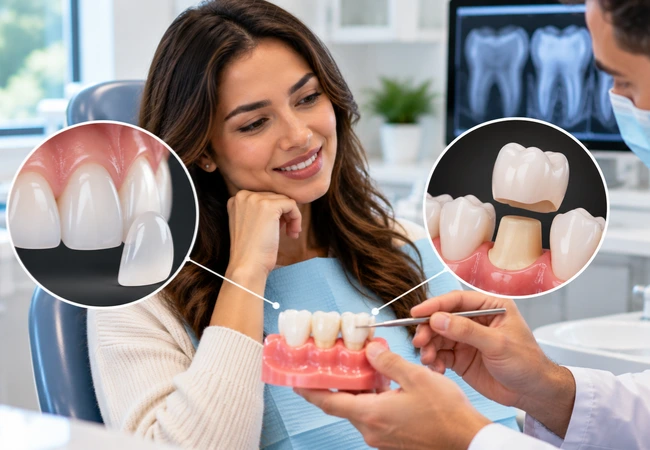
A veneer is a thin shell that covers only the front surface of your tooth. You can think of it like a false fingernail for your tooth.
To place a porcelain veneer, your dentist usually removes a very thin layer of enamel from the front of the tooth, often less than a millimetre. This makes room for the veneer so it doesn’t look bulky. The veneer is then bonded firmly to your tooth.
There are two main types:
- Porcelain veneers are made in a dental lab. They’re strong, stain-resistant, and look very natural because they reflect light like real enamel.
- Composite veneers are made from tooth-coloured resin and shaped directly on your tooth. They cost less and can often be done in one visit, but they stain and chip more easily and don’t last as long.
Veneers can fix:
- Stains that whitening can’t remove
- Small chips or worn edges
- Small gaps between teeth
- Teeth that are slightly uneven, short, or oddly shaped
What Is a Crown?
A crown, sometimes called a “cap,” covers the entire visible part of your tooth, the front, the back, the sides, and the biting edge.
To place a crown, your dentist removes more tooth structure all the way around. This creates space for the crown to fit over the tooth like a helmet. The crown then holds the tooth together and protects it from breaking.
Crowns can be made from different materials. For front teeth, dentists usually choose all-ceramic materials like porcelain or zirconia because they look the most natural. Learn more about the options in our guide to dental crowns in Vancouver.
Crowns can fix:
- Large cracks or broken teeth
- Teeth with large fillings or a lot of decay
- Teeth that are very worn down
- Teeth that have had a root canal and are weak
- Teeth with badly damaged old restorations
Which Is Better for Front Teeth?
This is the question most people really want answered. Here’s how to think about it, based on common situations.
Your Front Teeth Are Healthy but Stained, Chipped, or Uneven
Best choice: Veneers.
If your teeth are strong and your goal is mainly cosmetic, veneers are usually the better option. They give you a big change in how your smile looks while keeping most of your natural tooth.
One Front Tooth Has a Large Filling or a Big Crack
Best choice: Usually a crown.
A veneer needs enough healthy enamel to bond to. If a large part of the tooth is filling material or is cracked, a veneer may not hold well. A crown wraps around the whole tooth and protects it from breaking further.
Your Front Tooth Had a Root Canal
Best choice: It depends.
Front teeth that have had a root canal don’t always need a crown the way back teeth do. If most of the tooth is still intact, a smaller restoration may be enough. If the tooth is weak, darkened, or heavily filled, a crown is often recommended. Your dentist will check how much healthy tooth is left. Learn more in our guide to root canal treatment in Vancouver.
Your Front Teeth Are Worn Down From Grinding
Best choice: It depends on how worn they are.
Grinding can break veneers if it isn’t managed. For mild wear, veneers may still work, as long as you wear a night guard. For severe wear, crowns may be needed to rebuild the teeth properly. If you already use a guard, our tips on how to clean a night guard properly will help it last.
Your Front Teeth Are Crooked
Best choice: Possibly neither, at least not at first.
Veneers can hide slightly uneven teeth. But for moderate or severe crowding, straightening your teeth first with Invisalign is usually healthier. It can mean less tooth needs to be removed later, or that you won’t need veneers at all.
You Need Both on Different Front Teeth
This is more common than you think. For example, one front tooth may need a crown, while the teeth beside it only need veneers. When done carefully, crowns and veneers can be matched in colour and shape so your smile looks even and natural.
Cost: Veneers vs. Crowns
The cost of veneers and crowns depends on:
- The material (porcelain, composite, or zirconia)
- How many teeth you’re treating
- How much preparation each tooth needs
- Whether you need other treatment first, such as a root canal or gum treatment
Composite veneers are usually the most affordable option. Porcelain veneers and all-ceramic crowns usually cost more, but they tend to last longer.
Insurance and CDCP coverage can make a big difference. Most dental plans don’t cover veneers when they’re purely cosmetic. Crowns are more likely to be partly covered when they’re needed to protect a damaged tooth. The Canadian Dental Care Plan focuses on essential care and doesn’t cover cosmetic veneers. Our guide on what CDCP covers explains the details.
For a closer look at veneer pricing, read how much veneers cost in Canada.
What to Expect During Treatment
Getting Veneers
- Consultation and smile planning. Your dentist checks your teeth and gums and talks about the look you want.
- Tooth preparation. A thin layer of enamel is gently removed from the front of the tooth.
- Impressions or digital scans are taken so your veneers can be made to fit.
- Temporary veneers may be placed while your final ones are made.
- Bonding. Your final veneers are checked for fit and colour, then bonded to your teeth.
Composite veneers can often be done in a single visit because they’re shaped directly on your teeth.
Getting a Crown
- Exam and X-rays to check the tooth and its root.
- Tooth preparation. Any decay is removed, and the tooth is shaped all the way around. It may need to be built up first if a lot of it is missing.
- Impressions or digital scans of the tooth.
- A temporary crown protects your tooth while the final crown is made.
- Final fitting. Your dentist checks the fit, bite, and colour, then cements the crown in place.
How to Make Veneers or Crowns Last
- Brush twice a day and floss daily, especially along the gumline.
- Avoid biting hard things like ice, pens, or fingernails.
- Don’t use your teeth to open packages.
- Wear a night guard if you grind or clench your teeth.
- Limit coffee, tea, and red wine if you have composite veneers, since composite can stain over time.
- Keep up with regular checkups and cleanings.
Your natural teeth can still get cavities along the edges of a veneer or crown, so good daily care still matters.
Are There Alternatives?
Depending on your goals, you may not need veneers or crowns at all:
- Teeth whitening for mild stains. See our guide to professional teeth whitening in Vancouver.
- Cosmetic bonding for small chips and gaps, often in a single visit. Learn more about cosmetic bonding.
- Invisalign for crooked or crowded teeth.
If you plan to whiten your teeth, do it before getting veneers or crowns. Veneers and crowns won’t change colour with whitening, so your dentist will match them to your new, brighter shade.
Find the Right Option for Your Front Teeth at Stadium Dental
Choosing between veneers and crowns starts with understanding the health of your front teeth, not just how they look. At Stadium Dental, we check each tooth carefully so you can choose the option that looks great and keeps your smile healthy for years to come.
During your visit, we’ll look at how much healthy enamel you have, the condition of any old fillings, your bite, and whether you grind your teeth. Then we’ll explain whether veneers, crowns, or a combination of both makes the most sense, and why. Our goal is always to keep as much of your natural tooth as possible while giving you a result you’ll love.
We’ll also plan how your new smile will look before treatment begins. We use complimentary 3D digital scanning to plan precisely, and we match the shade, shape, and size of each veneer or crown to your face and your other teeth. If you need veneers on some teeth and crowns on others, we’ll make sure they blend together naturally. You can see examples of real results in our smile gallery.
We use high-quality, long-lasting materials, and we offer a warranty on our work because we stand behind the results we provide.
Depending on what your smile needs, we offer porcelain veneers, composite veneers, and dental crowns, along with teeth whitening and Invisalign.
Ready to find out which option is right for your front teeth? Book your consultation online, call us at 604-559-0299, or contact our team.
Frequently Asked Questions About Veneers vs. Crowns
What is the main difference between veneers and crowns?
A veneer covers only the front of your tooth and is mainly used to improve its appearance. A crown covers the whole tooth and is mainly used to protect and rebuild a tooth that is weak or damaged.
Which is better for front teeth, veneers or crowns?
For healthy front teeth with cosmetic concerns, like stains, chips, or small gaps, veneers are usually better because they remove less tooth structure. For front teeth that are cracked, heavily filled, badly worn, or weakened by a root canal, crowns are usually the better choice.
Do veneers or crowns last longer?
Porcelain veneers and crowns often last a similar amount of time, commonly 10 to 15 years or more with good care. Composite veneers usually last around 5 to 7 years. How long yours last depends on your habits, oral hygiene, and whether you grind your teeth.
Do veneers ruin your teeth?
Porcelain veneers require removing a thin layer of enamel, so the change is permanent. They don’t “ruin” your teeth, but you’ll always need a veneer or another restoration on those teeth. Composite veneers and minimal-prep veneers remove little or no enamel.
Can I get a veneer on a tooth that has a crown?
No. A veneer needs natural enamel to bond to, so it can’t be placed over a crown. If you want to change a crowned tooth, the crown can be replaced with a new one that better matches your smile.
Can I mix veneers and crowns on my front teeth?
Yes. Many people have a crown on one front tooth and veneers on the teeth next to it. With careful shade matching, they can look even and natural together.
Are veneers or crowns covered by insurance?
Veneers are usually not covered when they’re done for cosmetic reasons. Crowns are more likely to be partly covered when they’re needed to protect a damaged tooth. Check your plan, or ask our team to help you understand your coverage.
Do veneers and crowns look natural?
Yes. Porcelain veneers and all-ceramic crowns are custom-made to match the colour, shape, and translucency of natural teeth. When done well, most people won’t be able to tell you have them.
The Bottom Line
When comparing veneers vs. crowns, the right choice comes down to the health of your tooth. Veneers are ideal for healthy front teeth when you want a brighter, more even smile with minimal tooth removal. Crowns are best when a front tooth needs protection because it’s cracked, heavily filled, worn, or weakened.
The best way to know for sure is a personal consultation. Schedule your visit with Stadium Dental, and let our Downtown Vancouver team help you choose the option that makes your front teeth look and feel their best.