
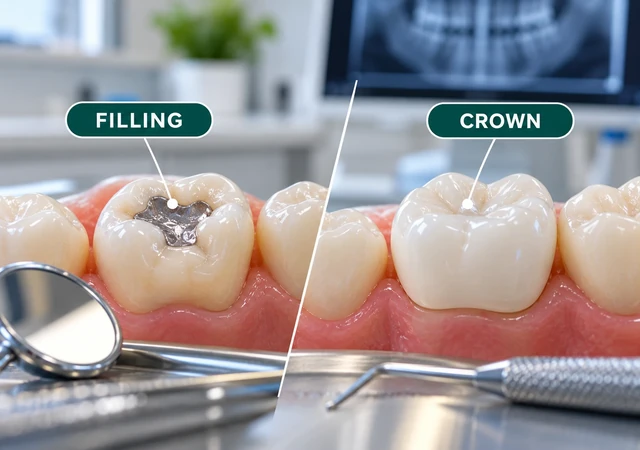
You’ve just been told you have a cavity or a damaged tooth. Your dentist mentions two options: a filling or a crown. One is quick and affordable. The other costs more and takes an extra visit. So which one do you really need? The answer depends on one main thing: how much healthy tooth you have left. A filling repairs a hole in a strong tooth. A crown protects a tooth that has become too weak to hold together on its own. This guide explains the difference between a crown vs. filling in plain language. You’ll learn when you need a crown, when a large filling is still enough, how they compare in cost and lifespan, and the signs your dentist looks for before recommending one.
The Quick Answer
- You usually need a filling when the damage is small to medium, and most of your tooth is still strong.
- You usually need a crown when the damage is large, the tooth is cracked, a big old filling is failing, or a back tooth has had a root canal.
Think of it this way: a filling patches the tooth, while a crown protects the whole tooth.
What Is a Filling?
A filling repairs a tooth that has a cavity or a small area of damage. Your dentist removes the decay, cleans the area, and fills the space with a strong material. This seals the tooth and brings back its shape so you can chew normally.
Fillings are usually done in one visit. The most common types are:
- Composite (tooth-coloured) fillings. These match the colour of your teeth and bond directly to the tooth. They’re the most popular choice today.
- Amalgam (silver) fillings. These are strong and long-lasting, but they’re more noticeable. Many people now choose tooth-coloured options instead.
- Glass ionomer fillings. These release a little fluoride and are often used for small areas near the gumline or in children’s teeth.
What Is a Crown?
A crown, also called a “cap,” covers the entire visible part of your tooth. Your dentist shapes the tooth all the way around, then places a custom-made crown over it, like a helmet. A crown holds the tooth together. It protects the tooth from cracking, restores its full shape, and lets you chew with confidence again.
Crowns usually take two visits: one to prepare the tooth and take a scan or impression, and another to place the final crown. Common materials include porcelain, zirconia, and gold. Learn more about the choices in our guide to dental crowns in Vancouver.
When Do You Need a Crown?
Your dentist may recommend a crown instead of a filling if any of the following apply to you.
1. The Cavity or Damage Is Too Large
When a cavity takes up a large part of your tooth, there isn’t much healthy tooth left around the filling. The remaining walls become thin and weak, and they can break when you bite down. A crown wraps around the tooth and holds it together.
2. Your Tooth Is Cracked
A crack can spread over time, especially with chewing pressure. A filling can’t stop a crack from growing, but a crown can hold the cracked pieces together and protect the tooth. Some cracked teeth hurt mostly when you bite down or release your bite.
3. A Back Tooth Has Had a Root Canal
After a root canal, back teeth (molars and premolars) often become more brittle. They also take a lot of chewing force. That’s why we usually recommend a crown to protect them. Learn more in our guide to root canal treatment in Vancouver.
4. A Large Old Filling Is Failing
Large fillings can wear down, crack, or leak over time, and the tooth around them may weaken. When it’s time to replace a big filling, there’s often not enough healthy tooth left for another one, so a crown becomes the better choice.
5. A Cusp Has Broken Off
Cusps are the pointed parts on the chewing surface of your back teeth. If one breaks off, or the tooth beneath it is badly undermined, a crown can rebuild and protect it.
6. Your Tooth Is Badly Worn
Grinding, acid erosion, or age can wear teeth down. A crown can rebuild a short, worn tooth to its proper shape and height.
7. You Need to Improve the Look of a Damaged Tooth
A crown can restore the shape and colour of a tooth that’s badly stained, misshapen, or broken. For healthy front teeth that only need a cosmetic change, a veneer may also be an option. See our guide to veneers vs crowns.
Large Filling vs. Crown: Where Is the Line?
This is where many people get confused. If a filling can fix your tooth for less money, why would you need a crown?
The answer comes down to how much healthy tooth is left to support the filling.
How Dentists Decide
Here’s a simple way to understand it. When a filling replaces a small part of your tooth, the strong tooth walls around it do most of the work, and the filling just fills the gap.
When a filling replaces a large part of your tooth, such as more than about half its width, or the side walls and cusps, the remaining tooth walls become thin. Every time you bite, these thin walls flex. Over time, they can crack, sometimes down into the root. A crack that reaches the root may mean the tooth can’t be saved.
Your dentist looks at:
- How wide and deep the damaged area is
- How thick the remaining tooth walls are
- Whether any cusps are weak or broken
- Whether the tooth has cracks
- How much force your bite puts on that tooth, especially if you grind
The Hidden Cost of a Very Large Filling
Choosing a large filling instead of a recommended crown can save money now. But if the tooth cracks later, you might need:
- A crown anyway
- A root canal and a crown
- An extraction and a tooth replacement, if the crack goes too deep
That’s why your dentist may suggest a crown before the tooth breaks, rather than waiting for a bigger problem. If a crack has already gone too far, read our guide on root canal vs extraction to understand your options.
The Middle Option: Inlays and Onlays
There’s also an option between a filling and a crown:
- An inlay fills a space within the chewing surface of the tooth.
- An onlay covers one or more cusps, but not the whole tooth.
Both are custom-made and bonded in place. They can be a good choice when the damage is too big for a regular filling, but the tooth is still strong enough that a full crown isn’t needed. They keep more of your natural tooth than a crown does. Ask your dentist whether one could work for you.
Signs Your Filling May Need to Be Replaced With a Crown
Watch for these signs around an older filling:
- Pain when biting or a sharp pain when you release your bite
- A crack you can see or feel in the tooth or filling
- A filling that feels rough, chipped, or loose
- Food getting stuck around the filling
- Dark edges or staining around the filling
- New sensitivity to hot, cold, or sweet foods
If you notice any of these, book a checkup. Catching a failing filling early can mean a simpler fix.
Cost: Crown vs. Filling
A filling costs less than a crown because it takes less time, uses less material, and usually needs only one visit. A crown costs more because it’s custom-made and requires more preparation and two visits.
But think about the long-term cost, too:
- For small damage, a filling is the clear winner on both cost and tooth preservation.
- For large damage, a crown often costs less over time because it protects the tooth from cracking, which could lead to a root canal or extraction.
Insurance and the CDCP: Most dental plans cover part of the cost of fillings, and many also cover part of a crown when it’s needed for your tooth’s health. The Canadian Dental Care Plan covers fillings for eligible patients, and some crowns may also be covered, often with approval in advance. Our guide on what CDCP covers explains more.
What to Expect During Each Treatment
Getting a Filling
- Your dentist numbs the area.
- The decay is removed, and the area is cleaned.
- The filling material is placed, shaped, and hardened.
- Your bite is checked and adjusted so it feels natural.
It’s usually done in one visit, and you can go back to your normal day right away.
Getting a Crown
- Your dentist numbs the area and removes any decay.
- The tooth may be built up if a lot of it is missing.
- The tooth is shaped all the way around to make room for the crown.
- A scan or impression is taken to make your custom crown.
- A temporary crown protects your tooth while you wait.
- At your next visit, the final crown is checked for fit, bite, and colour, then cemented in place.
Mild sensitivity after either treatment is common and usually fades within a few days.
How to Make Your Filling or Crown Last Longer
- Brush twice a day with fluoride toothpaste, and floss daily.
- Cut back on sugary snacks and drinks between meals.
- Avoid biting hard things like ice, pens, or hard candy.
- Wear a night guard if you grind your teeth. Here’s how to clean a night guard properly.
- See your dentist for regular checkups so small problems are caught early.
Keep in mind that a new cavity can still form at the edge of a filling or crown, so daily care still matters. If you keep getting cavities, our article on why you get cavities can help you understand why.
Get the Right Repair for Your Tooth at Stadium Dental
Choosing between a crown vs. filling should never be a guess. At Stadium Dental, we look closely at the health of your tooth so you get the repair it actually needs: no more, no less.
During your visit, we’ll examine your tooth, check for cracks, and take low-radiation X-rays to see how deep the damage goes. Then we’ll show you what we see and explain why a filling, a crown, or another option makes the most sense for your tooth. If a filling is enough, we’ll tell you. If your tooth needs more protection, we’ll explain why, so you can make the decision with confidence.
Our goal is to keep as much of your natural tooth as possible while making sure your repair is strong enough to last. We match tooth-coloured fillings and crowns to your natural teeth, so your repair blends in with your smile. We also use complimentary 3D digital scanning to help create crowns that fit comfortably and accurately.
Whether your tooth needs a dental filling or a dental crown, we can take care of it here. If the damage goes deeper, we also offer root canal treatment to save your tooth.
Not sure what your tooth needs? Book your appointment online, call us at 604-559-0299, or contact our team.
Frequently Asked Questions About Crown vs. Filling
Is a crown better than a filling?
Not always. A filling is better for small to medium damage because it’s quicker, costs less, and keeps more of your natural tooth. A crown is better when your tooth is cracked, heavily damaged, or weakened, because it protects the whole tooth from breaking.
When do you need a crown instead of a filling?
You usually need a crown when the cavity or damage is too large for a filling to hold, the tooth is cracked, a cusp has broken off, a large old filling is failing, or a back tooth has had a root canal.
How big is too big for a filling?
There isn’t one exact size, but as a general rule, when a filling would replace more than about half the width of your tooth, or when the tooth walls or cusps are thin or broken, a crown or onlay is usually the safer choice. Your dentist will check your tooth to decide.
Can a large filling be used instead of a crown?
Sometimes, yes, as a short-term option or when the tooth is still fairly strong. But a very large filling leaves the remaining tooth walls weak, which raises the risk of the tooth cracking later. Ask your dentist about the long-term risks before you decide.
Does getting a crown hurt more than a filling?
Both are done with local anesthetic, so you shouldn’t feel pain during treatment. A crown takes longer and may cause mild sensitivity or gum tenderness for a few days. Most people find both very manageable.
Can a crown be placed on a tooth that already has a filling?
Yes. In fact, many crowns are placed on teeth with large fillings. The old filling may be replaced or built up to give the crown a solid base.
How long do fillings and crowns last?
Fillings often last around 5 to 15 years, depending on their size, the material, and where they are. Crowns often last 10 to 15 years or longer. Good oral hygiene, regular checkups, and protecting your teeth from grinding help both last longer.
What happens if I choose a filling when I need a crown?
The filling may work for a while, but the weak tooth walls around it could crack. If the crack becomes severe, you might need a root canal, a crown, or even an extraction later.
The Bottom Line
When comparing a crown vs. filling, the right choice comes down to how much of your tooth is still healthy and strong. Fillings are ideal for small to medium repairs. Crowns are best when your tooth is cracked, heavily damaged, or weakened by a large filling or root canal. If you’re not sure what your tooth needs, the first step is a careful exam. Schedule your visit with Stadium Dental, and let our Downtown Vancouver team help you choose the repair that keeps your smile strong for years to come.